
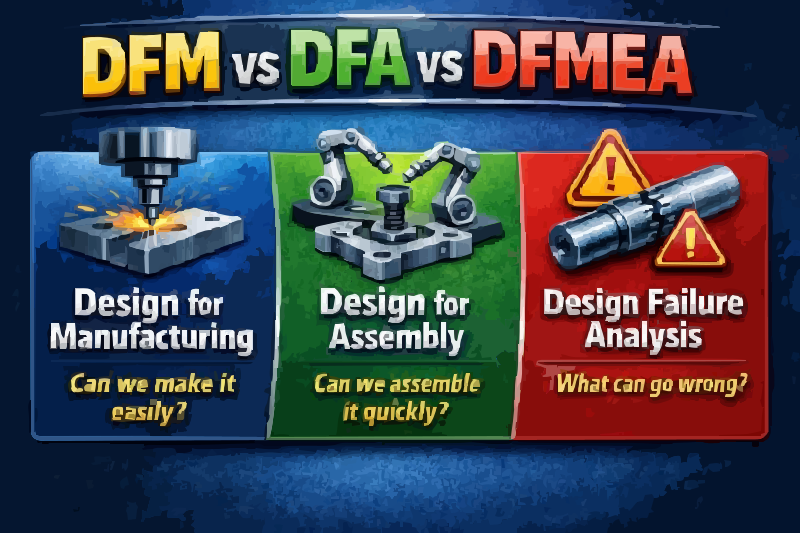
Design for Assembly (DFA)
Design for Assembly evaluates how easily and consistently components can be assembled. A DFA review considers part handling, orientation, locating, fastening, access, sequence, mistake-proofing and service requirements.
ENGINEERING TOPIC 01
DFA objectives
Reduce assembly difficulty while protecting product function.
Reduce unnecessary part count and joining operations.
Make components easy to handle and orient.
Provide clear locating and seating features.
Improve tool access and fastening consistency.
Reduce opportunities for incorrect assembly.
ENGINEERING TOPIC 02
Assembly sequence and access
Evaluate how the operator or automation reaches each joint.
Assembly direction and insertion path
Tool approach and reaction access
Fastener installation and torque access
Clip engagement visibility and feedback
Wire, seal and trim installation sequence
ENGINEERING TOPIC 03
Locating and mistake-proofing
Design features that guide parts into the correct position.
Asymmetric features where orientation matters
Locators and lead-ins
Connector keying and retention
poka-yoke concepts and verification
Clear inspection and confirmation points
ENGINEERING TOPIC 04
DFA review exercise
Review a multi-part trim or bracket assembly.
Map the current assembly sequence.
Identify handling, orientation and access difficulties.
Identify unnecessary parts or operations.
Recommend locating or retention improvements.
Check serviceability and validation impact.
Continue Learning
Explore related automotive engineering topics:
Design Failure Mode and Effects Analysis (DFMEA)Design Verification Plan and Report (DVP&R)Automotive APQP and PPAPAutomotive ECR and ECN Engineering Change Management
ASSEMBLY ENGINEERING
Evaluate the complete assembly process, not only the fastener
DFA assesses how parts are brought together, located, retained, connected and inspected. A component may be manufacturable on its own yet difficult to assemble consistently in the vehicle.
Core DFA review dimensions
| Review area | Engineering checks | Typical improvement direction |
|---|---|---|
| Part count and architecture | Are separate parts functionally necessary? Would consolidation create tooling, service or material issues? | Consolidate only where function, material, process, repair and recycling remain acceptable. |
| Orientation and handling | Can the operator identify the correct orientation? Are parts symmetrical or easy to confuse? | Add asymmetric location features, visual cues or poka-yoke geometry. |
| Location and retention | Are parts positively located before fastening? Can clips be engaged without damage? | Use lead-ins, locating pins, controlled clip engagement and clear seating conditions. |
| Access and sequence | Can tools, hands and connectors reach the joint in the required sequence? | Reorder operations, improve access or redesign the joint for the available envelope. |
| Quality confirmation | Can correct assembly be verified? Is a hidden or partial engagement possible? | Provide visible confirmation, poka-yoke and inspection points. |
| Service and repair | Can a service part be removed without damaging adjacent parts? | Consider replaceable fasteners, access openings and service sequence. |
Practical exercise: interior door trim installation
Map the sequence for a door trim panel with clips, screws, switch connector, handle cable and speaker interface. Identify the order in which the electrical connector, cable and fasteners must be accessed. Check whether the panel can be held in position while each connection is completed. Evaluate clip lead-in, retention force, panel alignment, tool access and the possibility of trapping a harness or weather barrier.
Draw the assembly sequence and identify operator hand positions and tool approach directions.
Mark locating features separately from retention features.
Identify any one-way or keyed connections and potential incorrect assembly modes.
Review whether a clip can be visually or tactually confirmed as engaged.
Consider service removal and replacement without damaging the substrate or clips.
Record proposed changes and assess their effects on cost, tooling, durability and appearance.
Expected deliverables: assembly sequence, interface/access review, DFA issue log, proposed improvement with trade-offs, and a verification checklist for the revised assembly.
Build your automotive engineering knowledge
Explore the technical subjects or contact MYTECHLEARN about your learning objectives.
Enquire Now