About MYTECHLEARN — Automotive Product Design Engineering Institute
MYTECHLEARN is an automotive product design and engineering training institute based in Hyderabad, India. We train mechanical, automobile and production engineers in the engineering logic that surrounds geometry — component function, material and process compatibility, manufacturing feasibility, assembly logic, dimensional management, risk analysis and controlled engineering change.
Explore Technical Programmes Book Free Technical Demo
01 · WHO WE ARE
Who We Are
MYTECHLEARN is an automotive product design and engineering training institute based in Hyderabad, India. We work with mechanical, automobile and production engineering students, fresh graduates, diploma holders, career-restart engineers and working professionals who intend to build careers in OEM research and development, Tier-1 product engineering, and automotive engineering service organisations.
Our subject is the engineering that surrounds the geometry — component function, material and process compatibility, manufacturing feasibility, assembly logic, dimensional management, risk analysis and controlled engineering change. Learners study how a component is justified before it is drawn, and how that justification survives tooling, assembly, inspection and production release.
Training is delivered through domain-based study and project-based application across Body-in-White, closures, interior trim, exterior systems, seating, lighting and electric vehicle structures, with core engineering methods — DFM/DFA, GD&T, DFMEA and DVP&R, ECR/ECN — embedded into each domain rather than taught as separate theory.
02 · WHY THE INSTITUTE WAS FOUNDED
Why the Institute Was Founded
- The distance between an engineering degree and a productive first year in automotive product development is not theoretical. It appears in specific, costly places:
- A component is modelled, but cannot be formed or moulded without defects because draft, draw depth, wall thickness or tool access were never assessed.
- An assembly is released, but cannot be located, fastened or serviced at line rate because sequencing and clearance were not engineered.
- Tolerances are assigned, but the datum scheme cannot be reproduced by inspection, so fitment problems surface at the trial stage.
- DFMEA is completed after the design is frozen, converting risk analysis into paperwork.
- Revisions proceed without change-control discipline, and drawing states, tooling and supplier documentation drift apart.
These are not knowledge failures alone. They are failures of engineering judgement applied at the right point in the development sequence. MYTECHLEARN was established to teach that sequence deliberately — the order in which feasibility, tolerance strategy, risk and change control must be addressed so that decisions hold up under review.
03 · ENGINEERING EDUCATION PHILOSOPHY
Our Engineering Education Philosophy
Learning follows the same progression as an actual development programme:
Vehicle and System Understanding
Architecture, zones, packaging envelopes and system relationships.
Component Understanding
Function, construction, interfaces, operating conditions and load paths.
Engineering Decisions
Material, geometry, joining method, manufacturing route and tolerance strategy.
Feasibility
Tooling capability, process limits, assembly sequence and cost consequences.
Verification
Failure modes, test linkage and validation evidence.
Product Development Discipline
Design reviews, supplier interfaces, documentation and controlled change.
The governing principle: an automotive design engineer must be able to state why a component is built the way it is, what it must survive, how it will be produced, how it will be assembled, and how its requirements will be proven. Anything short of that is representation, not engineering.
04 · CURRICULUM FOCUS
Why the Curriculum Focuses on Product Engineering, Not Tool Operation
Excluding tool instruction is a deliberate curriculum decision, not an omission.
A modelling tool records a decision. It does not make one. The differentiating capability in an R&D interview is the reasoning that precedes and follows the model: why a wall section is sized the way it is, which joining method the access geometry allows, what datum structure inspection can reproduce, and which failure mode justifies an added reinforcement.
Tool fluency is a baseline assumption in the industry. Judgement is the scarce capability. Our contact hours are therefore directed at design guidelines, engineering methods, feasibility assessment, dimensional strategy and change control — the areas where candidates are actually differentiated.
05 · VISION & MISSION
- Vision and Mission
- Vision
- Technically Credible, Practically Grounded
To be recognised as a technically credible automotive product development learning institute in India — one whose learners are assessed on engineering reasoning rather than attendance, and whose curriculum keeps pace with structural lightweighting, electric vehicle architecture, sealing and thermal integration, and increasingly digital validation workflows.
Mission
Engineers Who Contribute from Day One
To develop engineers who can contribute to product development from their first assignment by grounding them in component function and vehicle-level integration; training them in the design guidelines and engineering methods used across OEM and Tier-1 programmes; building manufacturing and assembly awareness into every design decision; developing dimensional management and risk analysis capability; and preparing them to document, defend and revise engineering decisions professionally.
06 · KNOWLEDGE FRAMEWORK
The Knowledge Framework
The technical capability pillars learners develop across the programme, mapped to the domains and methods they study.
| Capability Pillar | What Learners Develop |
|---|---|
| Component engineering | Purpose, construction, packaging, interfaces, load paths, mounting strategy and functional requirements |
| Materials and manufacturing | Ferrous and non-ferrous selection, engineering plastics, stamping, injection moulding, casting, extrusion, surface treatment, and process-capability limits |
| Design guidelines by domain | BIW load-path continuity and joining access; plastic trim attachment and moulding rules (interior); exterior mounting and draft strategy (exterior); seating structure and mechanism integration; EV enclosure sealing and thermal interfaces |
| Engineering methods | DFM, DFA, ASME Y14.5 GD&T, 1D/2D tolerance stack-up, DFMEA, DVP&R |
| Product development lifecycle | Benchmarking, concept definition, design release gates, APQP phases, PPAP evidence |
| Change management | ECR initiation, ECN release, impact assessment, revision and traceability control |
| Technical communication | Component study reports, design review participation, drawing interpretation, engineering documentation |
07 · OEM & TIER-1 CONTEXT
What OEM and Tier-1 Teams Actually Evaluate
Recruitment discussions for product engineering roles rarely stay at the definition level. The table below reflects the reasoning interviewers typically probe.
| Evaluation Area | Typical Line of Questioning | What a Prepared Engineer Demonstrates |
|---|---|---|
| Component reasoning | Why is this section, rib or reinforcement here? | Function-to-geometry traceability |
| Manufacturing feasibility | Can this be stamped or moulded without defects? | Awareness of draft, draw depth, wall thickness, tool access and springback |
| Assembly logic | How does this go together on the line, and how is error prevented? | Sequence thinking, locating strategy, Poka-Yoke awareness |
| Dimensional strategy | What datum scheme will inspection reproduce? | Functional datum selection and stack-up reasoning |
| Risk and validation | What fails, and how is it proven otherwise? | DFMEA-to-DVP&R linkage |
| Change control | How is a revision proposed, approved and communicated? | ECR/ECN discipline and traceability |
| Communication | Can you defend this in a design review? | Structured, evidence-based technical explanation |
08 · INDUSTRY MENTORS
Industry Experience Behind the Training
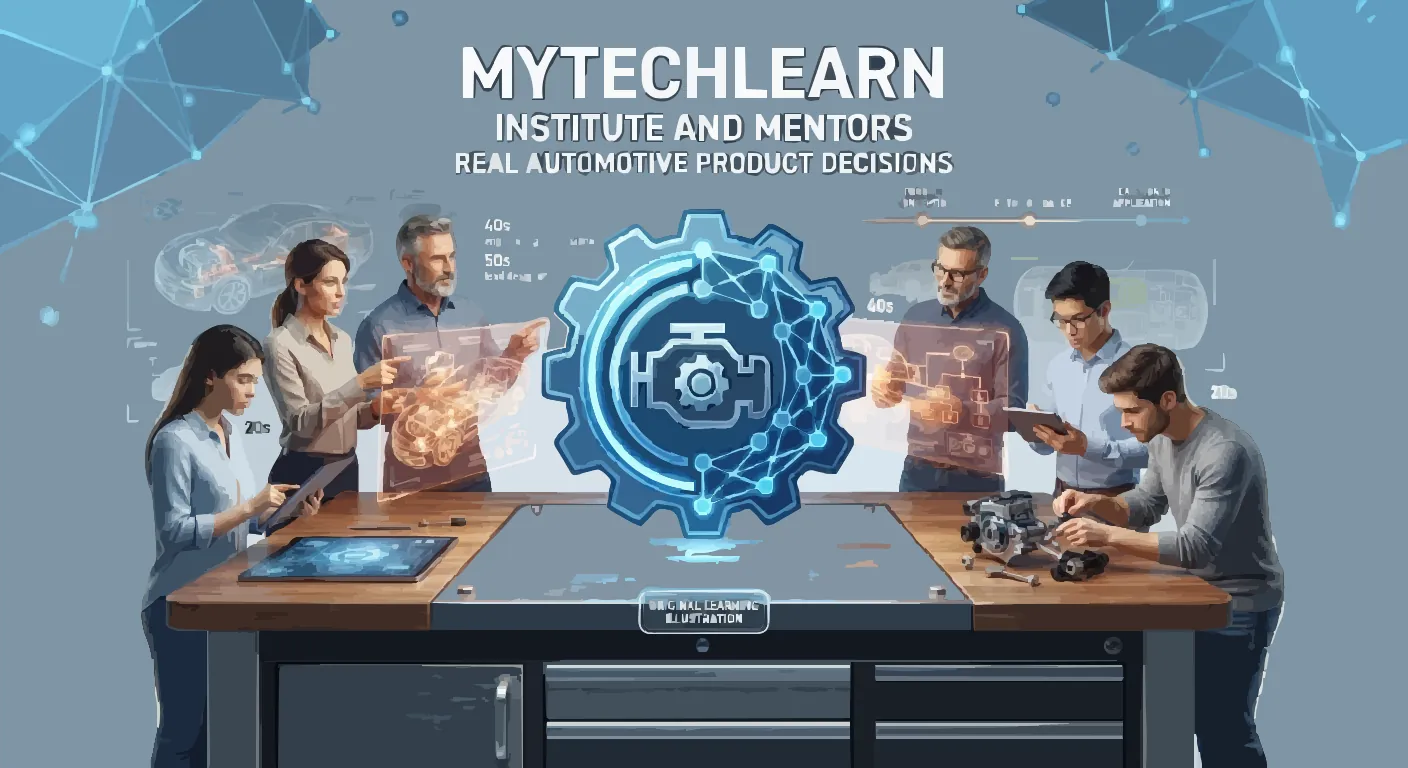
Mentor-led learning may connect engineering methods with product-development decisions across body structures, interior systems, exterior systems, powertrain, seating mechanisms and mechanism integration. Confirm the assigned mentor profiles and session plan for the selected cohort.
Mentor involvement converts methodology into practice: examples are drawn from real development decisions, tooling reviews and interface disputes rather than textbook illustration. Session allocation and mentor availability for a given cohort should be confirmed with the institute before enrolment.
09 · DELIVERY & ASSESSMENT
How Learning Is Delivered and Assessed
Domain modules are sequenced so that vehicle and component understanding precedes methods, and methods precede project application. Each domain closes with a component-level assignment that requires a written engineering position, not a model submission.
Typical deliverables. Component function and construction study; material and process selection rationale; DFM and DFA assessment; GD&T drawing with a worked stack-up; DFMEA extract with linked validation actions; ECR/ECN case file.
Assessment basis. Assignments are evaluated on four criteria: technical correctness, quality of engineering reasoning, documentation discipline, and the ability to defend the recommendation under questioning. The fourth criterion is deliberate — a design decision that cannot be defended in review is not yet an engineering decision.
10 · COURSE OUTCOMES
Course Outcomes
By completing a selected pathway and its required assignments, learners develop the following capabilities and the evidence that demonstrates them.
| Outcome | Evidence Produced |
|---|---|
| Explain vehicle architecture, zones and system relationships | Vehicle and system study |
| Analyse component function, construction and interfaces | Component study report |
| Select materials against functional and process requirements | Material selection rationale |
| Evaluate manufacturing feasibility and identify DFM risks | DFM assessment |
| Assess assembly sequence, locating and fastening strategy | DFA assessment |
| Interpret and apply GD&T, including datum strategy | Annotated drawing |
| Perform worst-case and RSS stack-up calculations | Worked stack-up sheet |
| Identify failure modes and link them to design actions | DFMEA extract |
| Define verification and validation activities | DVP&R plan |
| Explain APQP phases and PPAP evidence requirements | Process documentation summary |
| Apply ECR/ECN discipline with impact assessment | Change case file |
| Present and defend technical decisions in review conditions | Portfolio defence session |
Completion of training does not by itself confer independent design-release authority or OEM-level approval competence. That requires programme-specific experience, workplace responsibility and demonstrated performance.
11 · CAREER PATHWAYS
Career Pathways
Automotive product engineering knowledge supports a range of technical roles across OEMs, Tier-1 and Tier-2 suppliers, engineering R&D service providers, EV and mobility companies, and component manufacturers.
| Role | Technical Work Involved |
|---|---|
| Graduate Engineer Trainee | Component studies, drawing interpretation, supporting design revisions under supervision |
| BIW Design Engineer | Sheet-metal structure design, joining strategy, section and flange definition |
| Interior / Exterior Product Design Engineer | Plastic component design, attachment systems, moulding feasibility, fit and finish |
| Closures Design Engineer | Door, hood and liftgate structures, hinge and latch interfaces, sealing (covered under BIW Engineering) |
| Seating Design Engineer | Frame structures, mechanism integration, packaging and durability interfaces |
| EV Structural Design Engineer | Battery enclosure structures, sealing strategy, mounting and thermal interfaces |
| Manufacturing / DFM Engineer | Feasibility review, process capability, defect prevention at design stage |
| GD&T / Dimensional Engineer | Datum strategy, tolerance allocation, stack-up analysis, inspection planning |
| Product Validation Engineer | DVP&R execution, verification evidence, issue closure |
| Engineering Change Coordinator | ECR/ECN processing, impact assessment, revision and traceability control |
Employment sectors: passenger vehicle and commercial vehicle OEMs, two-wheeler manufacturers, Tier-1 and Tier-2 suppliers, engineering R&D service providers, EV and mobility companies, automotive lighting and seating suppliers.
Company names commonly referenced across the sector — including Tata Motors, Mahindra, Maruti Suzuki, Hyundai, Bosch, Valeo, ZF, Lear, Adient, Motherson and Tata Technologies — indicate the breadth of the employer ecosystem. They are not statements of recruitment partnership or hiring commitment.
12 · FREQUENTLY ASKED QUESTIONS
Frequently Asked Questions
Clear answers to help you understand the programme, domains and learning outcomes.
1. I am from a college with limited automotive exposure. Will I be able to follow the programme?
Yes. The programme starts with automotive fundamentals and gradually introduces component design, engineering principles and practical projects.
2. How does the institute decide which domain — BIW, interior, exterior, seating or EV — suits me?
We consider your educational background, interests, technical knowledge and career goals before recommending a suitable domain.
3. What does a project deliverable look like, and how is it graded?
You will work on practical automotive engineering projects. Your work is evaluated based on technical understanding, design approach, engineering considerations and project presentation.
4. Are internships included, or arranged separately?
Internship opportunities are provided or communicated separately, depending on programme structure and availability.
5. I work in quality or production. Can this training support a move into design?
Yes. The programme helps you understand automotive product design fundamentals, component engineering, design requirements and development processes.
6. How does the programme prepare me for job applications on Naukri, LinkedIn and company career pages?
We provide guidance on resume preparation, project portfolios, interview preparation and applying for relevant automotive design positions.
7. Is a certificate or a portfolio more valuable to an employer?
Both are useful. However, a technical portfolio demonstrating your engineering knowledge and practical project experience can provide stronger evidence of your skills.
8. How current is the curriculum on EV, lightweighting and sealing requirements?
The curriculum covers relevant automotive engineering developments, including EV systems, lightweight materials, sealing concepts and modern vehicle design requirements.
9. What should I check before joining any automotive design training institute?
Check the technical curriculum, trainer experience, practical projects, industry relevance, student support and transparency about placement claims.
10. Does the institute guarantee a job or a salary?
No. MYTECHLEARN does not guarantee jobs or salaries. We focus on developing industry-relevant engineering skills and providing career guidance to improve your employment readiness.
13 · HYDERABAD CENTRE
Hyderabad Centre and Learning Vision
Hyderabad anchors the institute within one of India's expanding automotive and engineering services clusters, alongside Pune, Chennai, Bengaluru and Delhi-NCR — the locations where product engineering roles concentrate.
Proximity to this ecosystem shapes the domains emphasised, the employer expectations discussed in sessions, and the interview patterns learners are prepared for.
MYTECHLEARN's learning approach combines domain-based technical study, practical exercises and engineering review. Current-cohort delivery arrangements are confirmed during counselling and provided in writing before enrolment.
14 · OUR COMMITMENT
Our Commitment
We commit to teaching engineering reasoning rather than tool operation; to stating outcomes honestly, including what training cannot deliver; to assessing work on technical merit rather than attendance; and to revising content as manufacturing methods, materials and vehicle architectures change.
Learners who complete the programme with genuine engagement should leave able to analyse a component, justify its construction, evaluate its manufacturability and assembly, define its dimensional strategy, identify its risks, and control its changes — and to explain all of that clearly, under questioning, to an engineering audience.
CONTINUE LEARNING
Continue Exploring Automotive Engineering
Explore our automotive engineering domains, product development methodologies, and technical learning resources to strengthen your understanding of the automotive industry.
- Automotive Product Design Engineering
- BIW Engineering
- Closures Engineering
- Interior Product Engineering
- Exterior Product Engineering
- Seating Engineering
- EV Engineering
- Materials & Manufacturing
- GD&T Training
- Tolerance Stack-Up
- DFM / DFA
- DFMEA & DVP&R
- ECR / ECN
- Engineering Case Studies
- Knowledge Hub
- Portfolio Assignments
- Interview Preparation
- Freshers' Fundamentals
- Connect with MYTECHLEARN
- Connect with our team to understand our automotive engineering learning approach and available technical programmes.
- Enquire Now