
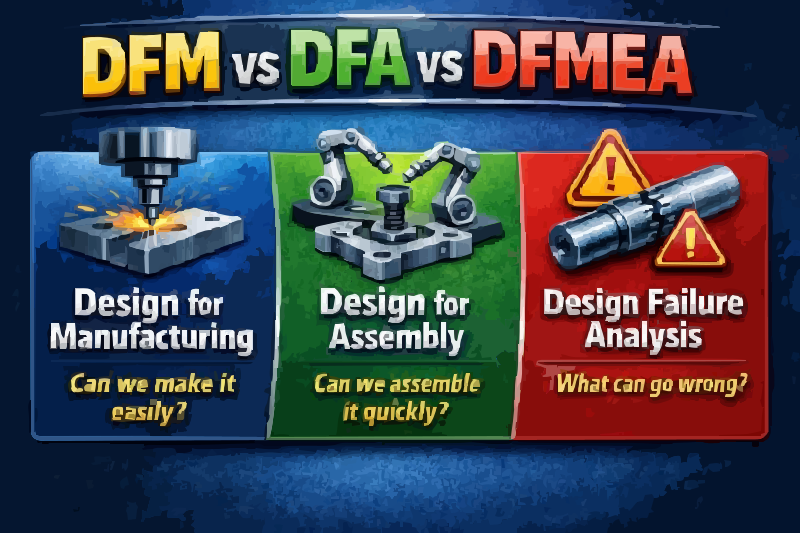
Design for Manufacturing & Design for Assembly (DFM / DFA)
Manufacturing and assembly decisions made after geometry freeze are expensive corrections. This programme builds the technical judgement to influence component and sub-assembly design before tooling commitment — the capability OEMs and Tier-1 suppliers expect from design and development engineers.
PROGRAMME OVERVIEW
Process-feasibility thinking, not software operation
Manufacturing and assembly decisions made after geometry freeze are expensive corrections.
This programme builds the technical judgement to influence component and sub-assembly design before tooling commitment — the capability OEMs and Tier-1 suppliers expect from design and development engineers. The focus is process-feasibility thinking, not software operation. You work with manufacturing constraints, assembly logic, engineering change discipline and production-cost trade-offs that determine whether a design survives the journey from release to stable production.
DFM and DFA are not late-stage checks. They are concurrent engineering disciplines that run alongside concept design, supplier nomination and APQP. The programme establishes where manufacturability and assembly reviews sit in the OEM development timeline and why early intervention protects cost, timing and quality.
TECHNICAL CONTENT OUTLINE
What the programme covers
1. DFM and DFA in the Automotive Product Development Cycle
DFM and DFA are not late-stage checks. They are concurrent engineering disciplines that run alongside concept design, supplier nomination and APQP. The programme establishes where manufacturability and assembly reviews sit in the OEM development timeline and why early intervention protects cost, timing and quality.
2. Design for Manufacturing Principles
Manufacturing feasibility is evaluated through process capability, tooling repeatability, material behaviour and production-rate requirements. You learn to assess a design against the constraints of the intended process rather than against a generic checklist.
3. Design for Assembly Principles
DFA reduces part count, assembly time, error potential and operator dependency. The programme covers assembly sequence logic, part orientation, handling difficulty, fastening strategy and poka-yoke integration from a design perspective. See Design for Assembly (DFA).
4. Component Function and Requirement Mapping
Every DFM/DFA recommendation must protect function. You practise tracing a feature back to its functional requirement, load path, interface condition and validation expectation before proposing a manufacturing-driven change.
5. Part Consolidation and Count Reduction
Fewer parts generally mean lower assembly variation and shorter cycle time — but consolidation can transfer cost and complexity into tooling. The programme teaches when consolidation is technically sound and when it merely shifts the problem.
6. Manufacturing Process Selection
Process selection is a design decision. You evaluate sheet-metal forming, plastic moulding, casting, extrusion and joining routes against volume, geometry, tolerance expectation and cost structure — without treating any single process as default.
7. Sheet-Metal Manufacturability
Automotive sheet-metal design is constrained by draw depth, bend radii, flange geometry, relief cuts, hole-to-edge distance, springback and thinning. The programme builds the ability to read a sheet-metal part and identify features that will drive tooling cost, scrap or dimensional variation. Explore BIW Engineering for body-in-white context.
8. Plastic Component Manufacturability
Plastic parts fail in production for predictable reasons: non-uniform walls, inadequate draft, poorly placed ribs and bosses, gate-position conflicts and uncontrolled shrinkage. You learn to review plastic geometry against moulding reality before tooling release. This applies directly to interior and exterior component design.
9. Injection-Moulding Design Considerations
The programme covers the design consequences of mould filling, packing, cooling and ejection — including weld-line location, flow-length limits, sink-mark risk and dimensional stability across the production window.
10. Draft, Wall Thickness and Rib Design
These are the highest-frequency DFM findings in automotive plastic and cast parts. The programme builds precision in specifying draft for release, maintaining wall uniformity, sizing ribs to stiffen without sink, and avoiding thick–thin junctions that create porosity, warpage or cosmetic defects.
11. Joining and Fastening Considerations
Spot welding, MIG/MAG, structural adhesive, clinching, riveting and threaded fastening each impose design rules on flange width, access, stack-up and material compatibility. You evaluate joining strategy as a design variable, not an afterthought. Refer to Materials & Manufacturing for material compatibility.
12. Assembly Accessibility and Operator Interface
A design that cannot be assembled comfortably, repeatedly and in the specified cycle time is not production-ready. The programme covers tool reach, hand access, visibility, part orientation and error-proofing through geometry.
13. Tooling and Fixture Accessibility
Design features that block tool access or prevent stable location in a fixture become recurring production losses. You learn to review component geometry for gauge location, clamping strategy and fixture repeatability.
14. Manufacturing Feasibility Reviews
A structured feasibility review tests design intent against process capability, supplier equipment, inspection method and production rate. The programme provides a review method that produces traceable, evidence-based findings rather than opinion-based comments.
15. Assembly Error Prevention Through Design
Poka-yoke at the design stage is more durable than operator training. You study geometry-based orientation control, asymmetric features, colour-independent mistake-proofing and assembly-sequence enforcement.
16. Cost and Weight Optimisation
DFM/DFA decisions directly affect piece cost, tooling amortisation, scrap rate, assembly labour and vehicle mass. The programme connects design choices to cost and weight outcomes so recommendations are commercially defensible.
17. Production-Process Constraints and Design Boundaries
Every manufacturing route has capability limits. You learn to recognise when a tolerance, surface finish, feature size or geometry exceeds normal process capability and what design response is technically appropriate. This links closely to tolerance stack-up and GD&T.
18. Design Feasibility Assessment
Feasibility assessment combines material, process, tolerance, volume and supplier-capability inputs. The programme builds a structured assessment method that can be applied to a new part or a proposed engineering change.
19. DFM/DFA Review Methodology
You work through a repeatable review workflow: define the manufacturing route, identify process-sensitive features, rank risk by severity and likelihood, propose design action, and record the technical rationale for supplier and cross-functional agreement. The risk-ranking logic complements DFMEA.
20. Engineering Change Discipline — ECN and ECR
Design improvements become real only when they pass through controlled change management. The programme covers the Engineering Change Request and Engineering Change Notice workflow, impact assessment, cross-functional approval, revision control and production cut-in planning — the process discipline OEMs and Tier-1 suppliers audit closely. See Product Development / ECR–ECN.
21. Practical Engineering Case Studies
Automotive component case studies are used to apply DFM, DFA, feasibility review and change-management logic to realistic production scenarios. The emphasis is on engineering reasoning, not software demonstration. Review the engineering case studies for context.
UNIQUE PROJECT
Manufacturing and assembly improvement dossier
Evaluate an automotive component and produce a manufacturing and assembly improvement dossier.
You select a production-representative component, define its likely manufacturing and assembly route, identify DFM/DFA risks using the review methodology taught in the programme, and propose design actions with technical justification. The output is structured as an engineering review document — the format used in OEM and Tier-1 design reviews — not a software operation model.
COURSE OUTCOME
What you will be able to do
On completing the programme, you will be able to:
Evaluate component geometry against sheet-metal, plastic and assembly process constraints before tooling release.
Apply DFM and DFA principles to identify manufacturability risks, assembly difficulty and avoidable part complexity.
Conduct structured feasibility reviews and produce traceable findings with severity, evidence and recommended design action.
Propose cost- and weight-conscious design changes that protect function, quality and production rate.
Navigate ECN/ECR workflows with an understanding of impact assessment, approval logic and production cut-in.
Communicate manufacturability and assembly decisions using the technical language expected in OEM and Tier-1 design and development reviews.
JOB OPPORTUNITIES
Where DFM/DFA competency is sought
DFM/DFA competency is sought across OEM product development, Tier-1 component engineering, supplier quality and manufacturing engineering functions.
Typical entry and early-career roles include:
Design Engineer — Product Development / Components
DFM/DFA Engineer — Automotive Components
Graduate Engineer Trainee — Design & Development
CDMM / STA Engineer (Supplier Technical Assistance)
Manufacturing Engineering Engineer — Assembly Process
Engineering Change Coordinator / PLM Support
Product Systems Design Engineer
OEMs and Tier-1 suppliers explicitly list DFM/DFA analysis, manufacturability review, tolerance awareness and engineering change management as required skills in design and development job descriptions. Fresh mechanical graduates who can demonstrate structured DFM/DFA reasoning — not just software familiarity — enter these roles with a credible technical differentiator.
FREQUENTLY ASKED QUESTIONS
Common questions about DFM/DFA training
1. What is the practical difference between DFM and DFA in automotive design?
DFM asks whether a component can be manufactured repeatedly to specification at the required rate and cost. DFA asks whether the product can be assembled efficiently, with low error potential and minimal part count. In practice they are reviewed together because a manufacturing-friendly part can still be assembly-hostile — and vice versa.
2. I am a fresh mechanical graduate. Do I need production experience to learn DFM/DFA?
No. DFM/DFA is a design-evaluation discipline. This programme teaches the process constraints and review logic that fresh graduates can apply directly to design decisions. The project and case studies are structured for candidates without prior shop-floor experience.
3. Will this programme teach software operation software?
No. software operation tools are explicitly outside the scope. The programme focuses on technical judgement — design guidelines, process feasibility, assembly logic, review methodology and engineering change discipline. The value lies in knowing what to change and why, not in operating a modelling tool.
4. What technical skills do OEM and Tier-1 design roles actually test in interviews?
Indian campus and lateral interviews commonly probe draft angle, uniform wall thickness, rib design, sheet-metal manufacturability, tolerance stack-up awareness, DFM vs. DFA definitions, manufacturability checks and the engineering change process. This programme is built around those exact competency areas.
5. How is ECN/ECR relevant to a fresher design engineer?
A design improvement that does not pass through controlled change management cannot reach production. Freshers entering OEM or Tier-1 design teams are expected to understand how an ECR is raised, how impact is assessed, how approval is recorded and how revision control works. This is process discipline, not paperwork — and it is audited.
6. Does DFM/DFA apply to EV components and battery-pack design?
Yes. Battery-pack enclosures, busbar assemblies, cooling plates, module housings and traction-motor components all require manufacturability and assembly review. The programme’s principles apply across conventional and electric vehicle programmes. See EV Engineering.
7. What kind of project will I complete?
You will evaluate an automotive component and produce a manufacturing and assembly improvement dossier — the same document logic used in OEM design reviews. It records the issue, process constraint, risk, proposed design action and validation need.
8. How does this training help me stand out on Naukri or in campus placements?
Most fresher profiles list software operation tools. Very few demonstrate structured DFM/DFA reasoning, feasibility-review output or change-management awareness. A completed project dossier and the ability to explain design trade-offs in interview language creates a defensible technical differentiator.
9. Is DFM/DFA only for plastics and sheet metal?
The principles are broader. Casting, extrusion, joining, fastening, assembly sequencing and tool access are all covered. The programme deliberately builds a process-agnostic evaluation method so you can assess an unfamiliar manufacturing route without relying on memorised rules.
10. What is the career progression from a DFM/DFA-focused start?
Typical progression moves from design/DFM engineer to component owner, supplier-facing CDMM/STA engineer, manufacturing engineering specialist or engineering change lead. Demonstrated manufacturability judgement and change-management experience are strong differentiators for these transitions.
Continue Learning
Explore related automotive engineering domains and methods:
BIW Engineering Closures Engineering Interior Product Design Exterior Product Design Seating Engineering EV Engineering GD&T Training Design for Assembly (DFA) DFMEA DVP&R ECR / ECN APQP & PPAP Tolerance Stack-up Materials & Manufacturing
Build OEM-ready design judgement
If your goal is an automotive design or development role where manufacturability, assembly logic and engineering change discipline are expected from day one, this programme is structured around that requirement.
Enquire Now