
Practical Automotive Engineering Assignments
Practical assignments help learners apply engineering concepts to realistic component and system problems. Each exercise should identify assumptions, use correct terminology and present a reasoned engineering conclusion.
ENGINEERING TOPIC 01
Component study assignments
Analyse components from different automotive domains.
Identify BIW front rail, pillar, rocker or cross member function.
Map a front door assembly and its mechanisms.
Analyse a B-pillar trim retention strategy.
Break down a front bumper assembly.
Map a headlamp assembly and its interfaces.
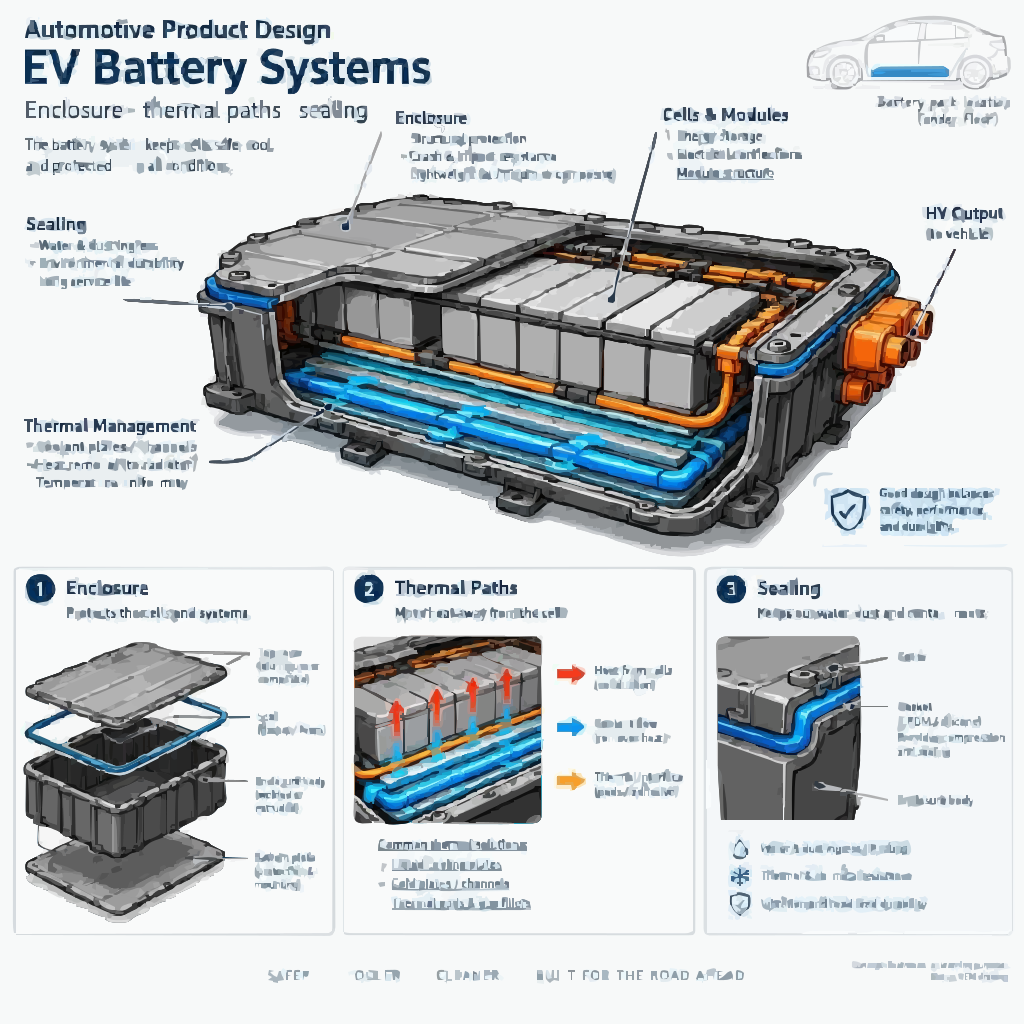
Study an EV battery enclosure and mounting system.
ENGINEERING TOPIC 02
Core engineering method assignments
Apply common product development tools.
Compare candidate materials for a bracket or trim.
Select a manufacturing process for a component.
Prepare a joining method comparison.
Create a simple tolerance chain and worst-case calculation.
Prepare a DFM and DFA review checklist.
Develop a small component DFMEA.
ENGINEERING TOPIC 03
Validation and quality assignments
Connect requirements to verification evidence.
Prepare a DVP&R for an interior trim component.
Create a basic inspection plan for critical dimensions.
Investigate a hypothetical fitment issue using 5 Why.
Prepare an engineering change impact matrix.
Present a structured design review.
ENGINEERING TOPIC 04
Submission format
Use a consistent format so the work can be reviewed.
Problem statement and component context
Function, interfaces and assumptions
Technical analysis, sketches and calculations
Material, process and joining recommendations
Risks, verification and conclusion
References and revision information
Continue Learning
Explore related automotive engineering topics:
Automotive Engineering Case StudiesAutomotive Technical Interview PreparationContact MYTECHLEARNAutomotive Engineering Knowledge Centre
ASSESSMENT & PORTFOLIO
Turn assignments into explainable engineering evidence
A useful engineering portfolio demonstrates reasoning, traceability and technical communication. It should show how a learner approached a defined problem, what assumptions were made, which methods were applied and how the proposed solution would be verified.
Suggested portfolio evidence by work type
| Evidence item | What it should demonstrate | Review criteria |
|---|---|---|
| Component study | Function, construction, interfaces, operating conditions and failure consequences. | Accuracy, completeness and clear system context. |
| Material/process rationale | Trade-offs between properties, process capability, cost, durability and sustainability. | Evidence-based selection with assumptions and constraints. |
| DFM/DFA review | Manufacturing feasibility, assembly sequence, access and error prevention. | Specific issues, feasible recommendations and impact assessment. |
| Dimensional study | Functional datum logic, tolerance chain and fitment implications. | Correct method, units, assumptions and interpretation. |
| DFMEA / DVP&R | Risk identification, action planning and requirement-linked verification. | Traceability and objective closure evidence. |
| Engineering change | Impact analysis, revision control and implementation planning. | Cross-functional completeness and controlled release logic. |
Example assignment: interior door trim engineering
Prepare a component breakdown of a door trim panel and map its interfaces to the door inner, carrier, switch pack, speaker, handle cable, wiring harness, weather barrier and glass run. Explain the selected polymer family using the supplied requirements. Review moulding considerations such as draft, wall transitions, ribs, bosses, sink risk and warpage. Define locating and retention features, assembly sequence, service removal and potential squeak/rattle paths.
Then identify critical-to-function dimensions, propose a functional datum strategy, create an illustrative tolerance chain for one interface, list credible failure modes and prepare a requirement-linked validation outline. Clearly label all assumptions and do not invent OEM specifications.
Portfolio integrity
Use original work or clearly cite permitted references.
Remove employer, customer, supplier and vehicle-programme confidential information.
Label simulated exercises as educational scenarios.
Show your own contribution and distinguish team output from individual work.
Include revision date, assumptions, source requirements and reviewer feedback where available.
Build your automotive engineering knowledge
Explore the technical subjects or contact MYTECHLEARN about your learning objectives.
Enquire Now