
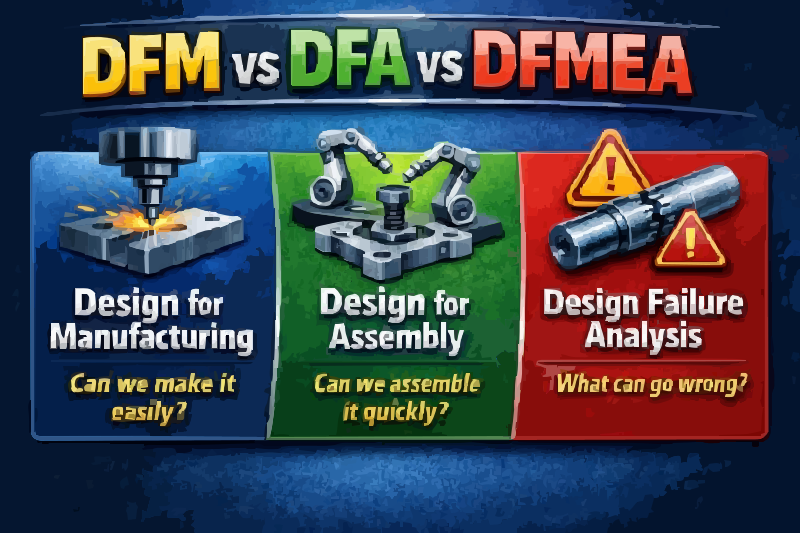
Design Failure Mode and Effects Analysis (DFMEA)
DFMEA is a structured method for identifying and reducing design-related risk. It connects product functions to potential failure modes, effects, causes, existing controls and actions that improve robustness.
ENGINEERING TOPIC 01
DFMEA structure
Build the analysis from the system and component functions.
Define scope, boundaries and analysis assumptions.
Identify functions and requirements.
Identify failure modes for each function.
Describe local, next-higher-level and end effects.
Identify causes and design-related mechanisms.
ENGINEERING TOPIC 02
Risk evaluation
Evaluate risk using the method required by the organisation or customer.
Severity of the effect
Occurrence likelihood of the cause
Detection or prevention/detection controls as defined by the method
Prioritise actions using the applicable AIAG-VDA or customer approach
Do not treat RPN as a universal acceptance criterion
ENGINEERING TOPIC 03
Action planning
Turn analysis into engineering improvements.
Define design prevention actions.
Improve detection or verification controls.
Assign owner and target date.
Record action evidence and revised ratings.
Link significant risks to DVP&R and design reviews.
ENGINEERING TOPIC 04
Practical DFMEA example
For a trim clip that may disengage, consider the function, retention loss, customer-visible gap or rattle, causes such as tolerance or material relaxation, and controls such as pull-off testing and dimensional review.
Define the clip retention requirement.
Identify credible failure modes and effects.
Evaluate causes and existing controls.
Recommend design or validation actions.
Document evidence and residual risk.
Continue Learning
Explore related automotive engineering topics:
Design Verification Plan and Report (DVP&R)Automotive APQP and PPAPAutomotive ECR and ECN Engineering Change ManagementAutomotive Quality Engineering
DESIGN RISK ENGINEERING
Build DFMEA from intended function and customer impact
DFMEA is a structured, cross-functional method for analysing how a product or design could fail to fulfil its intended functions. It supports risk reduction during design development; it is not a substitute for testing, compliance assessment or engineering approval.
Logical analysis sequence
Define scope: identify the system, subsystem, component, interfaces, boundaries and assumptions.
Describe functions: state what the item must do and the conditions under which it must operate.
Identify failure modes: describe the way the function could be lost, degraded or unintentionally performed.
Describe effects: explain consequences at the next higher level, vehicle level, customer or regulatory level as applicable.
Identify causes and mechanisms: consider geometry, material, loads, environment, misuse, assembly and interface conditions.
Record prevention and detection controls: distinguish actions that prevent the cause from methods that detect the issue.
Prioritise and act: apply the selected methodology and customer-specific rules to determine action priority.
Verify action effectiveness: update the analysis and link actions to drawings, tests, process controls or requirements.
Illustrative example: interior trim clip disengagement
| DFMEA element | Illustrative analysis |
|---|---|
| Function | Retain the trim panel to the door carrier over the specified vehicle life and operating environment. |
| Failure mode | Clip disengages or loses retention. |
| Potential effect | Loose trim, noise, visible gap, reduced perceived quality or interference with an adjacent feature. |
| Potential cause | Insufficient engagement, tolerance variation, polymer creep, incorrect clip orientation or local panel distortion. |
| Prevention direction | Review engagement geometry, material behaviour, tolerance chain, load path and assembly direction. |
| Detection / verification direction | Define retention and durability tests, dimensional checks and assembly confirmation appropriate to the requirement. |
This example is a training scenario, not a claim about an actual OEM failure. The team must use the applicable AIAG-VDA FMEA handbook or customer-mandated method, including the required structure, rating tables, action-priority rules and documentation conventions. Do not mix rating scales from different methods.
DFMEA quality checks
Failure modes are written as specific ways the function can fail—not as vague labels such as “poor quality”.
Effects describe consequences; causes describe mechanisms that create the failure.
Prevention controls address causes; detection controls identify the issue before release or use.
Actions have an owner, due date, status and objective evidence of completion.
Design changes are reflected in the DFMEA and linked verification evidence.
Build your automotive engineering knowledge
Explore the technical subjects or contact MYTECHLEARN about your learning objectives.
Enquire Now