
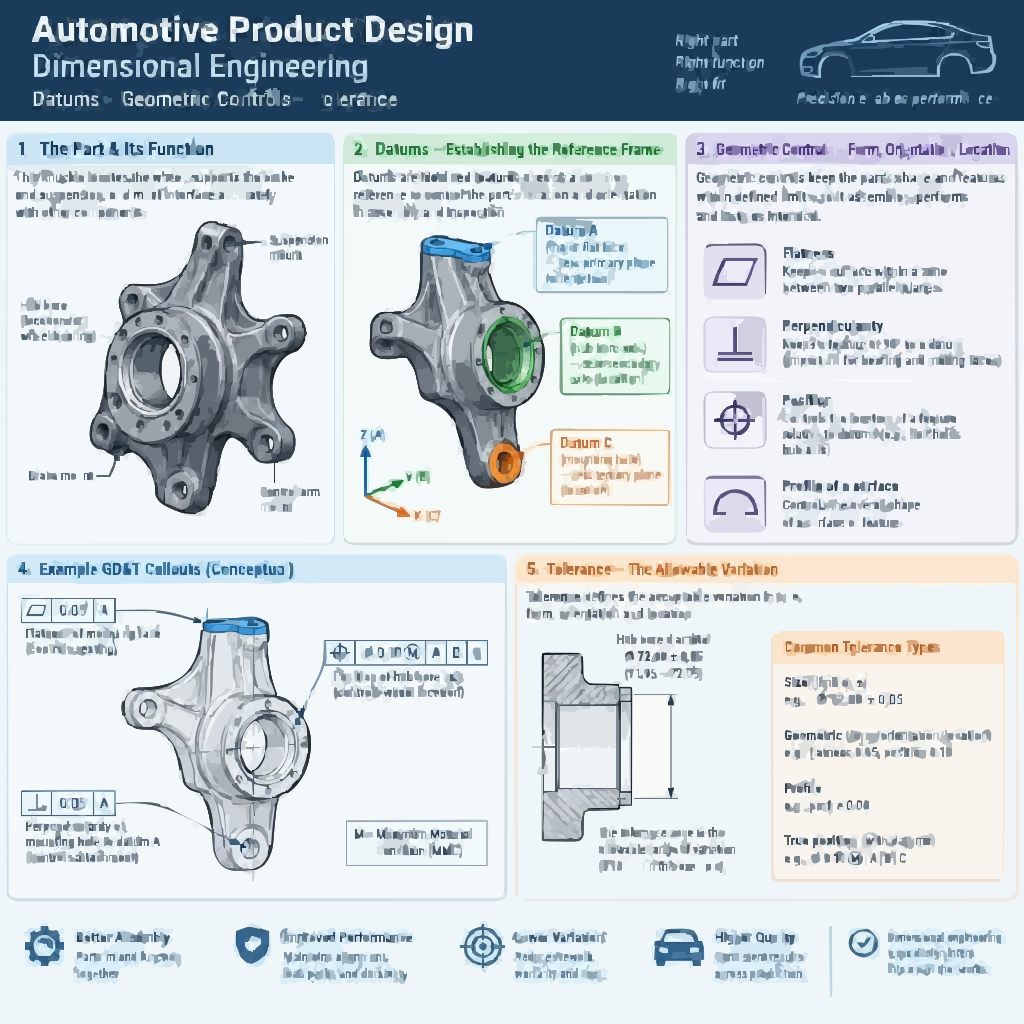
Dimensional Management & Tolerance Stack-up Analysis
Fit, flush, gap, alignment and engagement are not cosmetic outcomes. They are the visible result of how variation accumulates through every part, fixture, process and assembly step. Dimensional management is the discipline that predicts, controls and resolves that variation before it reaches the production line.
PROGRAMME OVERVIEW
Predict, control and resolve variation before production
Fit, flush, gap, alignment and engagement are not cosmetic outcomes.
They are the visible result of how variation accumulates through every part, fixture, process and assembly step. Dimensional management is the discipline that predicts, controls and resolves that variation before it reaches the production line.
This programme builds the technical judgement to define functional dimensions, allocate tolerances with evidence, execute worst-case and statistical stack-ups, and drive dimensional issue resolution in Body-in-White (BIW) and full-vehicle assemblies. The emphasis is on method and engineering reasoning, not software operation — the capability OEMs and Tier-1 suppliers expect from dimensional management, DVA and product development engineers. The programme sits alongside GD&T and DFM/DFA as a core product-development discipline within the OEM development timeline.
TECHNICAL CONTENT OUTLINE
What the programme covers
1. Dimensional Management Philosophy
Dimensional management is a lifecycle discipline, not a drawing check. It begins at concept feasibility, runs through datum strategy and tolerance allocation, and continues into fixture design, measurement planning, launch prove-out and post-SOP stabilisation. The programme establishes where dimensional decisions sit in the OEM product development timeline and why late correction is disproportionately expensive.
2. Functional Dimension Requirements
Every tolerance exists to protect a function: a gap specification, a flush target, a clearance, an engagement condition or a perceived-quality attribute. You learn to trace a dimensional requirement back to its functional and customer-perceived purpose before allocating tolerance or proposing a change.
3. Datum Planning and Datum Strategy
Datum selection determines what the measurement system can control. The programme covers functional datum identification, datum sequence, datum shift, over-constraint risk and the alignment of datum strategy with locating strategy in fixtures and assembly. A datum scheme that does not reflect the assembly locating condition produces dimensional data that cannot be acted upon. This connects directly to GD&T datum frameworks.
4. Tolerance Allocation
Tolerance allocation is a trade-off between functional requirement, process capability, tooling cost and inspection feasibility. You learn to distribute tolerance across a chain based on contributor sensitivity, process capability and the consequence of non-conformance — rather than applying uniform or arbitrary tolerances. Allocation decisions must respect the process boundaries discussed in DFM/DFA.
5. Assembly Variation
Variation enters an assembly through part variation, fixture variation, joining variation and sequence effects. The programme builds the ability to identify variation sources, separate contributor types and evaluate how assembly sequence and clamp plan affect the final dimensional outcome. Refer to Design for Assembly (DFA) for sequence and handling context.
6. Stack-up Methodologies — Worst-Case and Statistical
Worst-case analysis sums absolute tolerance contributions to establish guaranteed limits when every contributor aligns adversely. It is conservative but appropriate where functional limits must not be breached. Statistical stack-up — including root-sum-square (RSS) — combines independent contributions probabilistically. The programme teaches the assumptions behind RSS, when those assumptions are justified, and why RSS must never be presented as a guaranteed worst-case limit. Worked linear-chain examples are used to compare both methods against a functional acceptance criterion.
7. Gap and Flush Management
Gap and flush are the most visible dimensional outcomes in automotive exterior and interior fitment. The programme covers gap/flush target setting, contributor decomposition, sensitivity to datum and locator strategy, and the link between dimensional variation and perceived quality. High-visibility applications include exterior, interior, closures and seating interfaces.
8. BIW Dimensional Control
Body-in-White dimensional control is the foundation of vehicle-level fitment. You study panel-level and sub-assembly-level dimensional requirements, weld and joining effects, clamp plan influence, closure fitment and the progression from part measurement to complete BIW dimensional validation. Explore BIW Engineering for the body-structure context.
9. Fixture and Locating Strategy
Fixtures translate datum strategy into physical constraint. The programme covers locating principles, over-constraint avoidance, clamp sequencing, fixture repeatability and the dimensional consequences of fixture design decisions. Tool accessibility and measurement access are treated as design requirements, not downstream concerns.
10. Process Variation and Capability
Dimensional outcomes are process outcomes. You learn to interpret Cp, Cpk, Pp and Ppk in the context of dimensional performance, distinguish between common and special-cause variation, and use capability data to challenge or validate tolerance assumptions. Capability inputs are drawn from the processes covered in Materials & Manufacturing.
11. Measurement and Inspection Strategy
A dimensional requirement that cannot be measured reliably cannot be controlled. The programme covers measurement system planning, CMM and gauge strategy, fixture correlation, MSA and Gauge R&R logic, and the alignment of inspection method with the tolerance being verified. Verification planning integrates with DVP&R.
12. Dimensional Issue Resolution
Dimensional problems rarely have a single cause. You work through a structured resolution method: define the symptom, isolate contributor variation, test root-cause hypotheses against measurement data, implement corrective action and verify dimensional recovery. The focus is on evidence-based problem-solving, not opinion-driven adjustment. The risk-thinking approach parallels DFMEA.
13. Engineering Tolerance Reviews and ECN/ECR Discipline
Tolerance changes are engineering changes. The programme connects dimensional review output to the Engineering Change Request and Engineering Change Notice workflow — impact assessment, cross-functional approval, revision control and production cut-in. Tolerance optimisation without change-control discipline creates configuration risk. See Product Development / ECR–ECN and APQP & PPAP for the change-control and launch context.
14. Quality Improvement Case Studies
Automotive BIW and full-vehicle case studies are used to apply dimensional management logic to realistic fitment, gap/flush and launch-quality scenarios. The emphasis is on engineering reasoning and traceable decision-making. Browse the engineering case studies for related examples.
UNIQUE PROJECT
Dimensional management dossier
Develop a dimensional management dossier for an automotive assembly or sub-assembly.
You define a functional dimensional requirement, construct the dimensional chain, select and apply worst-case and statistical stack-up methods, evaluate datum and locating strategy, and propose tolerance or process actions with technical justification. The output follows the structure of an OEM dimensional review document — requirement, chain, analysis, risk, recommendation and validation — not a software exercise.
COURSE OUTCOME
What you will be able to do
On completing the programme, you will be able to:
Construct and directionally validate dimensional chains for gap, flush, clearance, alignment and engagement requirements.
Execute worst-case and statistical (RSS) stack-up analyses with an explicit statement of assumptions and limitations.
Evaluate datum and locating strategies for functional alignment with assembly and measurement conditions.
Interpret dimensional capability data (Cp, Cpk, Pp, Ppk) and use it to challenge or validate tolerance allocation.
Diagnose assembly variation across part, fixture, joining and sequence contributors using structured root-cause logic.
Link tolerance decisions to ECN/ECR discipline, impact assessment and production cut-in.
Communicate dimensional findings in the technical format expected by OEM and Tier-1 dimensional management, DVA and product development teams.
JOB OPPORTUNITIES
Where dimensional management competency is sought
Dimensional management and tolerance stack-up competency is explicitly listed in automotive OEM and Tier-1 job descriptions for design, variation analysis, manufacturing engineering, supplier quality and launch support functions.
Typical entry and early-career roles include:
Dimensional Management Engineer — BIW / Exterior / Interior
Dimensional Variation Analysis (DVA) Engineer
Design Engineer — Tolerance Stack-up and GD&T
BIW Design / Dimensional Control Engineer
Manufacturing Engineer — Dimensional Validation and Launch
Supplier Quality / STA Engineer — Dimensional Quality
Graduate Engineer Trainee — Body Engineering / Product Development
Global OEM programmes and Indian Tier-1 suppliers routinely require 1D and 3D tolerance stack-up capability, datum strategy definition, gap and flush planning, and measurement system alignment as core skills for these roles.
FREQUENTLY ASKED QUESTIONS
Common questions about dimensional management
1. What is the practical difference between GD&T and tolerance stack-up analysis?
GD&T defines the allowable variation on a feature — form, orientation, location and profile. Tolerance stack-up analysis evaluates how those individual allowances accumulate through an assembly and whether the resulting functional condition (gap, flush, clearance, engagement) is acceptable. GD&T is the specification language; stack-up is the system-level consequence check. See GD&T Training.
2. I am a fresh mechanical graduate. Do I need production or BIW experience to learn dimensional management?
No. Dimensional management is a design-evaluation and variation-prediction discipline. This programme teaches the chain construction, datum logic, stack-up methods and measurement principles that fresh graduates can apply to design and feasibility decisions without prior shop-floor experience. The project is structured for candidates without a production background.
3. Will this programme teach 3DCS or other tolerance simulation software?
No. Software operation is outside the scope. The programme focuses on method and judgement — chain construction, worst-case and RSS logic, datum strategy, contributor sensitivity and the assumptions behind statistical methods. The value lies in knowing what the analysis means, when it is valid, and what action the result demands.
4. What technical skills do OEM and Tier-1 dimensional management interviews actually test?
Indian interviews for dimensional management, DVA and BIW roles commonly probe datum selection and sequence, tolerance stack-up methods (worst-case vs. RSS), gap and flush contributor logic, GD&T interpretation, measurement and fixture strategy, Cp/Cpk interpretation and structured dimensional issue resolution. This programme is built around those exact competency areas.
5. Why is worst-case analysis still taught if RSS is more realistic?
Worst-case analysis establishes guaranteed limits and is required where functional failure is unacceptable. RSS is a probabilistic estimate that depends on distribution and independence assumptions. A competent dimensional engineer knows when each method is appropriate and never presents an RSS result as a guaranteed worst-case limit. The programme teaches both methods and their validity boundaries.
6. How does ECN/ECR relate to tolerance changes?
A tolerance change is an engineering change. Without ECN/ECR discipline, tolerance optimisation can create configuration mismatch between design, tooling, inspection and production. The programme connects dimensional review output to impact assessment, cross-functional approval and production cut-in — the change-management discipline OEMs and Tier-1 suppliers audit. See ECR / ECN.
7. Is dimensional management only relevant to BIW and exterior panels?
BIW and exterior fitment are high-visibility applications, but the principles apply to interior modules, closures, chassis interfaces, battery-pack assemblies and EV component integration. The programme builds a transferable variation-management method, not a narrow BIW-only checklist. Related domains include Interior, Closures, Seating and EV Engineering.
8. What kind of project will I complete?
You will develop a dimensional management dossier for an automotive assembly or sub-assembly. It includes the functional requirement, dimensional chain, worst-case and statistical stack-up, datum and locating evaluation, risk statement and recommended action — structured as an OEM dimensional review document.
9. How does this training help me stand out on Naukri or in campus placements?
Most fresh mechanical profiles list software operation tools. Very few demonstrate the ability to construct a dimensional chain, interpret a stack-up result, question a datum strategy or explain the difference between worst-case and statistical variation. A completed dimensional dossier and the ability to defend tolerance decisions in interview language creates a defensible technical differentiator.
10. What is the career progression from a dimensional management start?
Typical progression moves from dimensional management engineer or DVA engineer to senior DVA specialist, dimensional engineering lead, BIW dimensional control owner or launch-quality dimensional lead. Demonstrated stack-up judgement, datum strategy ownership and cross-functional issue resolution are the strongest differentiators for these transitions.
Continue Learning
Explore related automotive engineering domains and methods:
BIW Engineering Closures Engineering Interior Product Design Exterior Product Design Seating Engineering EV Engineering GD&T Training DFM / DFA DFMEA DVP&R ECR / ECN APQP & PPAP Materials & Manufacturing Case Studies
Build OEM-ready dimensional judgement
If your goal is an automotive design, variation analysis or body engineering role where datum strategy, tolerance stack-up and dimensional issue resolution are expected from day one, this programme is structured around that requirement.
Enquire Now