
Automotive Product Design & Development Engineering Programme
A domain-led pathway for engineers who need to understand how automotive components are specified, engineered for production, assessed for fitment and dimensional control, verified and released. Develop the technical judgement expected across OEM and Tier-1 product development environments.
Discuss Your Learning PathwayRequest Programme Details
01 · PROGRAMME INTENT
Prepare to contribute to product engineering work
Automotive product engineering is a connected discipline. A component must satisfy its intended function, interface correctly with neighbouring systems, suit its material and manufacturing route, assemble consistently, meet dimensional requirements and demonstrate performance through verification and validation.
This programme develops those connected capabilities through technical instruction, guided analysis, domain assignments, case-based problem solving and structured project reviews. Learners are expected to explain the engineering basis for their decisions and identify where further data, testing or specialist approval is required.
The programme is intended for mechanical and automobile engineering graduates, diploma holders and working professionals seeking a structured route into automotive component and product development roles.
02 · COMPETENCY FRAMEWORK
Six pillars organise the technical learning
Pillar 1
System engineering & component integration
Translate vehicle-level needs into component responsibilities and interface conditions.
Vehicle architecture and system decomposition
Functional analysis and engineering specifications
Interface definition, packaging and clearance
Load paths, operating conditions and adjacent-part interaction
Requirements traceability and change impact
Pillar 2
Component engineering & design guidelines
Evaluate how component architecture, geometry and material influence performance and robustness.
Part construction, functional zones and feature hierarchy
Wall sections, ribs, bosses, flanges and mounting features
Clips, snap-fits, fasteners and retention strategy
Material behaviour, environmental exposure and durability
Ergonomics, appearance, serviceability and misuse conditions
Pillar 3
Manufacturing & assembly feasibility
Anticipate production constraints before design maturity and tooling commitment.
Stamping, moulding, casting, extrusion and machining considerations
Draft, undercuts, parting lines and tooling access
Joining selection: welding, adhesive, riveting, screws and clips
Assembly sequence, poka-yoke and operator access
DFM, DFA, process capability and service access
Pillar 4
Dimensional & geometric engineering
Control variation so components locate, assemble and function as intended.
Functional datum selection and datum reference frames
GD&T interpretation and application principles
Worst-case and statistical tolerance stack-up
Gap-and-flush strategy and variation contributors
Measurement, gauging and inspection considerations
Pillar 5
Verification, validation & reliability
Connect engineering requirements to risk controls and objective evidence.
DFMEA structure, failure chains and action effectiveness
Design verification and validation strategy
DVP&R, test methods and acceptance criteria
Durability, thermal, vibration, environmental and functional concerns
Failure analysis, 5 Why, Ishikawa and 8D fundamentals
Pillar 6
Product development & release management
Understand the governance that moves a product from definition to controlled production.
Development phases, design gates and review inputs
APQP, PPAP, supplier readiness and quality planning
ECR/ECN initiation, impact analysis and approvals
BOM, configuration, revision and document control
Release evidence, traceability and production feedback
03 · DEVELOPMENT SEQUENCE
Follow the engineering lifecycle from need to production learning
Requirements→Design→Feasibility→Validation→Release
The sequence below is the programme's organising logic. Individual projects may iterate between stages as requirements, test results or supplier constraints change.
Requirements & programme targets
Customer needs, engineering specifications, CTQs, operating conditions, regulatory considerations and acceptance criteria.
Vehicle architecture & system definition
Vehicle zones, functional breakdown, component boundaries, interfaces, packaging and system dependencies.
Component concept & design intent
Component function, architecture, construction, material options, key features and performance targets.
Feasibility & production planning
Manufacturing route, joining, assembly, tooling constraints, serviceability, cost and supplier input.
Dimensional strategy
Functional datums, GD&T, tolerance allocation, stack-up, gap-and-flush and inspection planning.
Risk & validation planning
DFMEA, prevention and detection controls, verification methods, DVP&R and acceptance criteria.
Product and process readiness
APQP activities, process flow, control plan awareness, supplier coordination and PPAP deliverables.
Review, change & release
Design reviews, ECR/ECN, impact assessment, approvals, revision control and release documentation.
Launch feedback & improvement
Production issues, nonconformance, root-cause analysis, corrective action and lessons learned.
04 · DOMAIN PATHWAYS
Choose a product area for deeper engineering application
The common competency framework is applied differently in each vehicle domain. The specialisation determines the components, failure modes, manufacturing routes and validation concerns studied in detail.
| Domain | Engineering focus | Typical component studies |
|---|---|---|
| BIW & structural systems | Structure, stiffness, crash load paths, forming, joining, corrosion and dimensional strategy | Cross members, pillars, rails, reinforcements and brackets |
| Closures | Opening systems, mechanisms, sealing, hemming, durability and fit-and-finish | Doors, hood, liftgate, hinges, latches and seals |
| Interior systems | Polymer component design, attachment, appearance, occupant interaction and noise concerns | Door trim, instrument panel, console, pillar trim and ducts |
| Exterior systems | External polymer parts, impact considerations, mounting, surface quality and environmental exposure | Bumper, fascia, grille, cladding and underbody shields |
| Seating systems | Structure, mechanisms, occupant packaging, load transfer and durability | Seat frame, recliner, track, adjuster and trim interfaces |
| Lighting systems | Optical function, thermal management, sealing, mounting and regulatory awareness | Headlamp, rear lamp, housing, lens and adjuster interfaces |
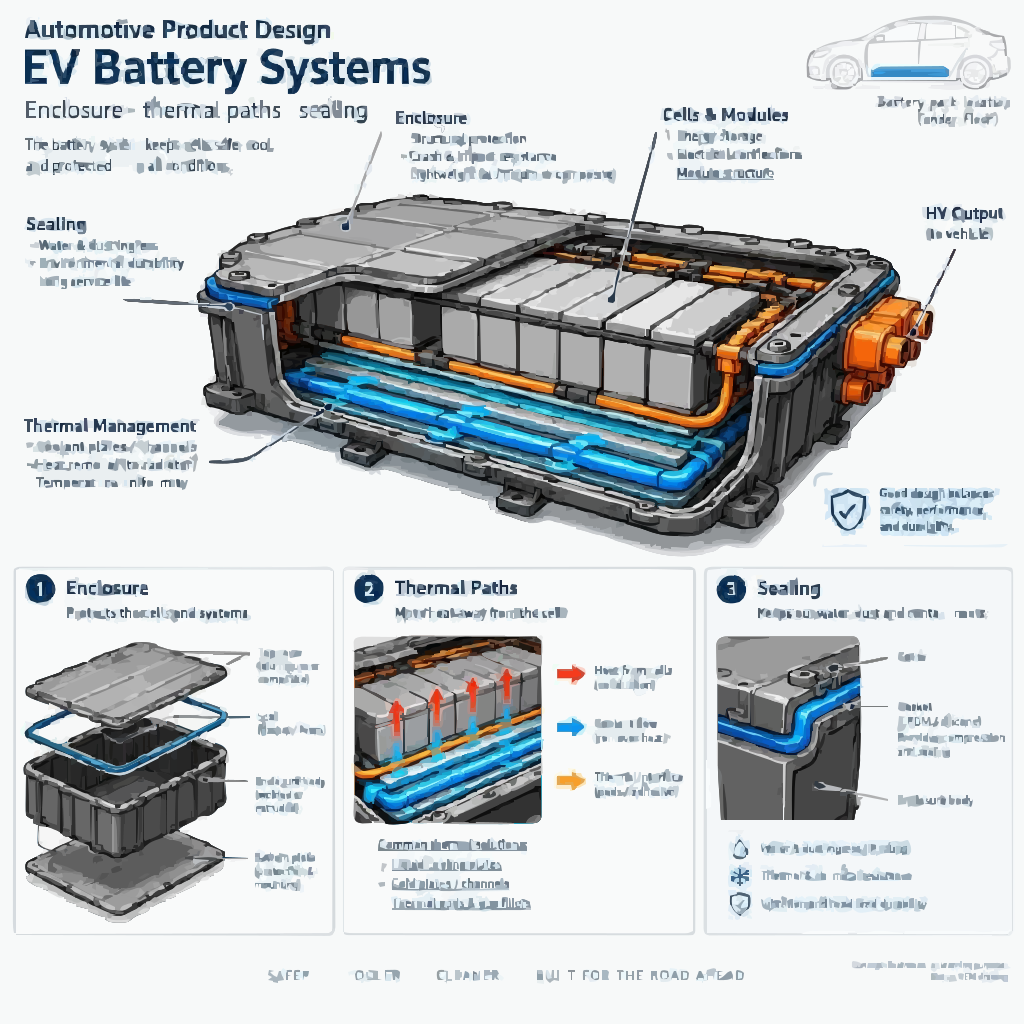
| EV product systems | Battery enclosure integration, protection, thermal interfaces, sealing and service safety | Battery tray, cover, brackets, mounts and protective structures |
05 · METHODS IN PRACTICE
Apply engineering methods to component decisions
| Method | What learners practise | Decision or output |
|---|---|---|
| DFM | Process selection, feature feasibility, tooling limitations and defect prevention | Manufacturing feasibility review with design recommendations |
| DFA | Part count, orientation, access, fastening, sequence and error-proofing | Assembly analysis and improvement proposal |
| GD&T | Functional datums, geometric controls, tolerance intent and inspection feasibility | Datum and control strategy for a defined interface |
| Tolerance stack-up | Variation contributors, worst-case calculation and statistical interpretation | Stack-up worksheet and gap/flush risk assessment |
| DFMEA | Function, failure mode, effect, cause, prevention and detection controls | Risk analysis with prioritised actions |
| DVP&R | Requirement-to-test traceability, test conditions and acceptance criteria | Verification and validation plan |
| APQP / PPAP | Development planning, process readiness, evidence and submission structure | Deliverable map and readiness review |
| ECR / ECN | Change justification, technical impact, approval flow and implementation control | Change record with traceable implementation plan |
Supporting topics include automotive benchmarking, requirements engineering, design for quality, design for cost, reliability, supplier engineering, product lifecycle management and regulatory awareness. These are integrated where they are relevant to a domain or project rather than treated as disconnected theory.
06 · PROJECT APPLICATION
Project work should demonstrate engineering reasoning
Projects are designed around a technical question and a reviewable output. The purpose is to practise a structured engineering approach—not to imply that an academic exercise is an approved OEM design.
Structural case
BIW bracket and reinforcement study
Review load transfer, material and gauge considerations, joining access, corrosion risk and datum strategy.
Evidence: functional analysis, feasibility checklist and dimensional-control proposal.
Cabin systems case
Door trim module integration
Assess carrier, armrest, switch pack, map pocket and attachment interfaces for function, assembly and service.
Evidence: component map, interface matrix, DFA review and risk register.
Polymer case
Exterior fascia feasibility
Consider material selection, moulding constraints, mounting, dimensional variation and environmental exposure.
Evidence: material-process rationale and DFM recommendation.
Mechanism case
Closure interface and gap study
Evaluate hinge/latch relationships, sealing, flush targets, tolerance contributors and durability concerns.
Evidence: interface diagram, stack-up logic and validation questions.
EV structure case
Battery enclosure concept review
Study enclosure protection, sealing, mounting, thermal interfaces, serviceability and structural integration.
Evidence: requirement map, risk assessment and verification outline.
Change control case
Engineering change impact assessment
Trace a proposed material or interface change through function, fit, process, quality, documentation and approvals.
Evidence: ECR, impact matrix, ECN plan and revision record.
Explore more learning examples in the engineering case-study library and assignment framework.
07 · ASSESSMENT & PORTFOLIO
Assess the quality of the engineering argument
Learners are reviewed on how accurately they interpret the problem, use relevant engineering principles, recognise assumptions and limitations, and communicate a defensible recommendation.
Technical correctness and understanding of component function
Quality of requirements and interface interpretation
Appropriate application of methods and calculations
Awareness of manufacturing, assembly and service constraints
Traceability between risk, prevention and validation
Clarity of drawings, reports, matrices and review presentations
Ability to respond to technical questions and revise work
Recognition of unresolved risks and need for specialist validation
Portfolio principle: every major project should contain the problem statement, assumptions, inputs, analysis, decision rationale, review comments and final revision. Evidence must be genuine learner work and should not disclose confidential employer information.
08 · PROGRAMME DELIVERY
A staged pathway with defined learning milestones
A six-month integrated pathway may be structured as follows. Actual batch calendar, contact hours, assessment schedule and domain selection must be confirmed with MYTECHLEARN before enrolment.
| Stage | Indicative period | Learning milestone | Review evidence |
|---|---|---|---|
| Automotive foundation | Month 1 | Vehicle systems, component functions, materials and processes | Vehicle system map and component study |
| Domain specialisation | Months 2–3 | Domain architecture, design guidelines, interfaces and performance | Component dossier and interface analysis |
| Production feasibility | Month 4 | DFM, DFA, joining, dimensional strategy and quality considerations | Feasibility review and tolerance exercise |
| Risk and development control | Month 5 | DFMEA, DVP&R, APQP/PPAP and ECR/ECN | Risk file, validation plan and change case |
| Integrated project | Month 6 | Apply the lifecycle and present engineering recommendations | Final technical dossier and review presentation |
Programme duration and guided learning hours are cohort-specific and should be confirmed in the written programme schedule. Completion is based on the stated assessment requirements.
09 · CAREER READINESS
Prepare for role-specific technical conversations
The programme supports preparation for relevant entry-level and early-career opportunities across automotive OEMs, Tier-1 suppliers, engineering service providers and product development organisations.
| Role direction | Interview themes to prepare |
|---|---|
| Component / Product Engineer | Function, architecture, interfaces, materials, design guidelines and change rationale |
| Domain Engineer – BIW, Closures, Trim, Exterior, Seating or EV | Domain components, packaging, manufacturing routes, joining, performance and validation |
| DFM / DFA Engineer | Process constraints, assembly sequence, tooling access, part consolidation and error-proofing |
| Dimensional Engineer | Datums, GD&T, tolerance allocation, stack-up and inspection approach |
| Quality / Validation Engineer | DFMEA, DVP&R, test criteria, failure analysis and corrective action |
| Engineering Change Coordinator | ECR/ECN workflow, impact analysis, revision management and traceability |
Career support may include profile guidance, technical interview preparation and placement assistance as defined by the selected programme. No course can guarantee a job, salary, employer selection or OEM approval.
10 · STANDARDS & TECHNICAL DISCIPLINE
Use standards with context and revision control
Automotive engineering work uses customer-specific requirements, international standards and regional regulations. Learners should understand the purpose and limits of a standard and verify the applicable revision for each programme or project.
ASME Y14.5 principles for dimensioning and geometric tolerancing, where specified
AIAG core tools and automotive quality planning concepts where applicable
Customer-specific requirements and supplier quality requirements
Relevant AIS, CMVR and UNECE regulatory provisions for the vehicle market and system
Material, environmental and test standards selected for the component application
Controlled technical documents with revision, source and applicability recorded
Training examples are educational. Final engineering decisions require current standards, approved specifications, competent review and the relevant organisation's release process.
11 · PROGRAMME QUESTIONS
Before selecting your pathway
Is this a general mechanical engineering course?
Does the programme include software operation training?
Can I specialise in one automotive domain?
Will I work on projects?
Are all engineering values fixed across components?
Does the programme guarantee an OEM or Tier-1 job?
How do I know which pathway is appropriate?
12 · RELATED TECHNICAL PATHWAYS
Explore a specific engineering discipline
Component EngineeringPackaging & Interface EngineeringMaterials EngineeringManufacturing ProcessesJoining TechnologyDFMDFAGD&TTolerance Stack-UpDFMEADVP&RAPQP & PPAPECR & ECNQuality EngineeringDesign Reviews
Build a pathway around your target engineering role
Speak with MYTECHLEARN about domain selection, technical depth, project expectations, programme schedule and assessment before making an enrolment decision.
Book a Free Demo