
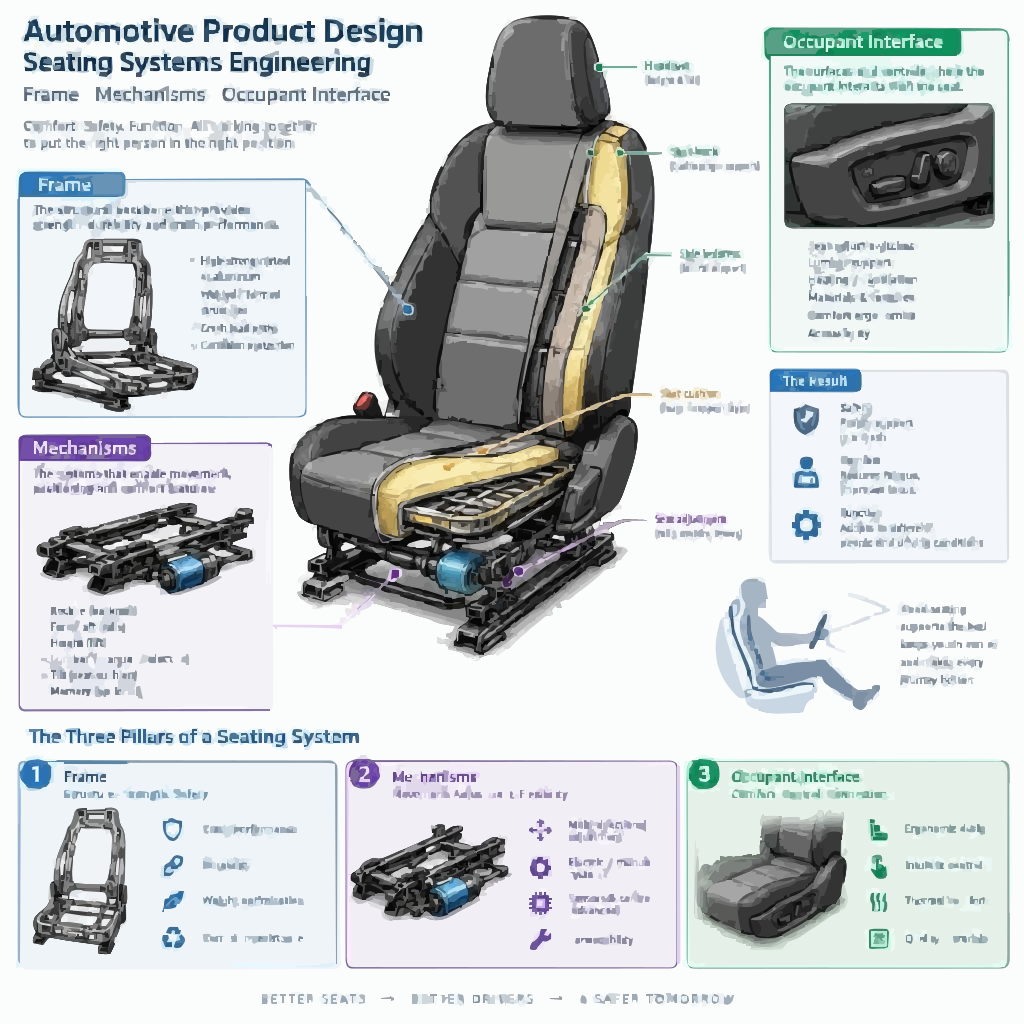
Automotive Seating Design Engineering Training
Automotive seating is a critical vehicle subsystem that combines structural engineering, mechanical mechanisms, occupant ergonomics, materials, comfort, safety and manufacturing. Build production-ready seating competence for OEM and Tier-1 roles — with emphasis on engineering decisions and production readiness.
Enquire About Seating TrainingRequest Domain Curriculum
01 · PROGRAMME INTRODUCTION
Why Automotive Seating Engineering
Developing an automotive seat requires more than understanding individual components. Engineers must evaluate structural load paths, adjustment mechanisms, occupant packaging, seat-to-body interfaces, material behaviour, assembly requirements and validation targets.
The Automotive Seating Design Training programme at MYTECHLEARN focuses on these engineering responsibilities through domain-specific technical learning and practical development projects. Learn how automotive seats are engineered from initial system requirements through concept development, component engineering, design verification, manufacturing feasibility and engineering release.
The programme emphasises the technical knowledge and engineering methods relevant to automotive OEMs and Tier-1 seating suppliers.
Technical learning areas
Seat architecture and subsystem engineering.
Cushion frame and backrest structural design.
Recliner, slide rail and height adjustment mechanisms.
H-point, occupant packaging and ergonomics.
Foam, trim and material engineering.
Restraint system and safety interface considerations.
Manufacturing processes, joining and assembly.
DFM, DFA, GD&T and tolerance stack-up.
DFMEA, DVP&R, APQP and PPAP awareness.
ECR, ECN and engineering change management.
02 · SYSTEM UNDERSTANDING
Understanding Automotive Seating Engineering
Automotive seating engineering involves the development of complete seating systems to satisfy vehicle packaging, occupant comfort, structural performance, safety, durability, manufacturing and quality requirements. A typical automotive seating system consists of several interconnected engineering subsystems.
1. Seat Structure
The structural assembly supports the occupant and transfers loads through the seat structure and mounting interfaces. See Component Engineering.
Key components:
Cushion frame
Backrest frame
Side members and cross members
Reinforcement brackets
Head restraint support
Seat mounting brackets
2. Seat Adjustment Mechanisms
Mechanical systems provide occupant adjustment and seat positioning. See Joining Technology for mechanism assembly coverage.
Recliner mechanism
Fore-aft sliding tracks
Height adjustment mechanism
Lumbar adjustment system
Folding and tumble mechanisms
Manual and powered adjustment systems
3. Foam and Trim Engineering
Foam and trim components influence comfort, appearance, durability and occupant contact. See Materials Engineering.
Key considerations:
Polyurethane foam density and hardness
Cushion and backrest support
Foam thickness and pressure distribution
Trim material selection
Stitching and seam design
Cover attachment and retention
Wear and abrasion resistance
4. Occupant Ergonomics and Packaging
Seat geometry must accommodate different occupant sizes while maintaining the required vehicle interior packaging. See Packaging & Interfaces.
H-point and seating reference points
Seat adjustment range
Headroom and legroom
Thigh and back support
Visibility and reach
Entry and exit clearance
Seat-to-console and seat-to-door interfaces
5. Safety and Restraint Integration
Seat engineering must consider applicable occupant protection requirements and vehicle safety interfaces.
Seat structural strength
Seat belt anchorage interfaces, where applicable
Head restraint positioning and performance
Side-airbag module integration
Child restraint anchorage interfaces
Seat attachment and floor load transfer
03 · ENGINEERING RESPONSIBILITIES
What Automotive Seating Engineers Need to Know
A seating engineer must understand the complete product development process and make technically justified design decisions. The following engineering responsibilities form the core of this programme.
| Engineering responsibility areas and technical scope | Engineering responsibility areas and technical scope |
|---|---|
| Area | Technical Scope |
| Structural engineering | Understand frame architecture, load transfer, structural members, reinforcements, material grades, thickness selection and joint design. See Component Engineering. |
| Mechanism engineering | Understand recliner operation, locking systems, sliding tracks, height adjusters, folding mechanisms, kinematics and operational requirements. |
| Foam and trim engineering | Study foam characteristics, comfort requirements, trim attachment, stitching, material durability and manufacturing constraints. |
| Ergonomics and packaging | Understand occupant positioning, H-point, seating reference dimensions, adjustment envelopes and vehicle interior interfaces. |
| Manufacturing and joining | Evaluate stamping, tube forming, welding, fastening, foam moulding, trim sewing and production assembly feasibility. See Manufacturing Processes and Joining Technology. |
| Validation and quality | Understand structural testing, mechanism durability, dimensional verification, DFMEA, DVP&R and engineering change control. |
04 · TECHNICAL CURRICULUM
Detailed Technical Curriculum
The curriculum progresses from basic automotive seating knowledge to subsystem engineering and production-development methodologies across nine modules.
Module 01
Automotive Seating System Fundamentals
Understand the architecture, terminology and engineering requirements of passenger vehicle seating systems. Start with Automotive Fundamentals.
View topics
Focus: Understand how the complete seat assembly functions and how individual subsystems interact.
Module 02
Seat Structural Design Engineering
Study the structural design of seat frames and their associated components.
Focus: Structural integrity, strength, stiffness, weight, manufacturability and reliable load transfer.
Module 03
Seat Mechanisms and Mechanical Engineering
Understand the mechanical systems responsible for seat adjustment, movement and locking.
Focus: Mechanical function, kinematics, locking reliability, movement, packaging and assembly feasibility.
Module 04
Occupant Ergonomics and Seating Packaging
Study the relationship between occupant geometry, seat position and vehicle interior packaging.
Focus: Occupant accommodation, dimensional consistency, comfort, visibility and vehicle packaging.
Module 05
Foam, Trim and Comfort Engineering
Understand the materials and manufacturing methods used in seating comfort systems. See Materials Engineering.
Focus: Comfort, material behaviour, mouldability, appearance, durability and repeatable assembly.
Module 06
Automotive Seating Safety Engineering
Understand safety interfaces, structural integrity, occupant protection and coordination with vehicle safety teams.
Focus: Safety interfaces, structural integrity, occupant protection and coordination with vehicle safety teams.
Module 07
Materials, Manufacturing and Joining Technology
Understand material selection, manufacturing feasibility, joint reliability, cost and production consistency. See Materials and Joining.
Focus: Material selection, manufacturing feasibility, joint reliability, cost and production consistency.
Module 08 · Core
Automotive Design Engineering Methods
Core job-oriented module. Focuses on the engineering methods used to develop, review and release automotive seating components.
View methods
Practical exercises: evaluate a seat frame for stamping/welding feasibility; identify CTQs; prepare a GD&T strategy; calculate a seat mounting tolerance stack; prepare a subsystem DFMEA; develop a risk-based DVP&R outline; evaluate a material or thickness change; prepare an ECR/ECN with impact assessment.
Module 09
Validation, Quality and Production Readiness
Understand design verification, product reliability, manufacturing quality and production readiness.
Focus: Design verification, product reliability, manufacturing quality and production readiness.
05 · STANDARDS AWARENESS
Engineering Standards and Industry Practices
Automotive seating engineers must understand the regulatory environment and customer-specific engineering requirements relevant to their product. The programme introduces the purpose and engineering implications of the following references.
| Standards and engineering relevance | Standards and engineering relevance |
|---|---|
| Standard / Reference | Engineering Relevance |
| FMVSS 207 | Seating systems and structural performance |
| FMVSS 210 | Seat belt assembly anchorage strength and location |
| FMVSS 202a | Head restraint performance |
| FMVSS 208 | Vehicle occupant crash protection |
| FMVSS 225 | Child restraint anchorage systems |
| UN Regulation No. 17 | Seat strength, seat anchorages and head restraints |
| UN Regulation No. 14 | Safety-belt anchorage requirements |
| SAE J826 | H-point machine and seating accommodation measurement |
| IATF 16949 | Automotive quality management system requirements — see Quality Engineering |
| AIAG-VDA FMEA | Failure Mode and Effects Analysis methodology — see DFMEA |
Additional engineering references include applicable Indian CMVR and AIS requirements, OEM-specific seating design specifications, customer material specifications, component validation specifications, supplier manufacturing and quality requirements, and internal design standards and engineering procedures.
Important boundary: The exact applicable regulation, amendment series, vehicle category and test procedure must be confirmed for each vehicle programme. Training covers engineering awareness and interpretation; it does not constitute regulatory certification or homologation.
06 · PRACTICAL PROJECTS
Practical Automotive Seating Engineering Projects
The projects are designed to help learners apply engineering concepts to realistic seating development situations. The emphasis is on engineering decisions, calculations, technical reasoning and documentation rather than software modelling exercises.
| Project studies, learning activities and deliverables | Project studies, learning activities and deliverables | Project studies, learning activities and deliverables |
|---|---|---|
| Project | Learning Activities | Deliverables |
| 01 · Front Seat Structural Engineering | Identify structural members and reinforcements; study load paths and mounting interfaces; select suitable materials and thicknesses; evaluate welding and forming feasibility; identify critical structural joints. | Component engineering report, material selection sheet, load-path assessment, DFM checklist, technical design review. |
| 02 · Recliner and Slide Rail Mechanism Study | Understand recliner working principles; study track locking and release mechanisms; evaluate mechanism clearances; identify mounting and assembly interfaces; assess operational and durability requirements. | Mechanism function report, interface study, tolerance analysis, assembly feasibility assessment. |
| 03 · Foam and Trim Engineering | Evaluate foam density and hardness; study cushion support and thickness distribution; identify trim attachment methods; understand foam tooling and demoulding; evaluate stitching and cover manufacturability. | Material specification, foam engineering report, trim attachment strategy, manufacturing feasibility checklist. |
| 04 · H-Point and Occupant Packaging Study | Understand H-point references; evaluate seat travel and adjustment range; study headroom and legroom; check door and console interfaces; evaluate reach and visibility considerations. | Occupant packaging assessment, dimensional study, interface review. |
| 05 · DFM, DFA and Production Engineering | Review component manufacturing processes; identify welding and fastening constraints; develop an assembly sequence; identify poka-yoke opportunities; evaluate inspection and quality requirements. | DFM/DFA report, assembly sequence, critical characteristic list, manufacturing review. |
| 06 · DFMEA, DVP&R and Engineering Change | Identify possible design failure modes; prepare a subsystem DFMEA; develop a risk-based verification plan; evaluate an engineering change; prepare ECR and ECN documentation. | DFMEA extract, DVP&R plan, ECR, ECN, design change impact assessment. |
Project scope note: These are structured training and simulated engineering exercises. They should not be represented as actual OEM-approved designs, production releases or authorised supplier projects.
07 · CASE STUDIES
Engineering Case Studies and Problem-Solving Exercises
In industry, engineers are expected to identify problems, understand their root causes and recommend technically feasible solutions. The programme uses representative seating engineering scenarios to develop this ability.
| Case studies, engineering considerations and expected learning | Case studies, engineering considerations and expected learning | Case studies, engineering considerations and expected learning |
|---|---|---|
| Case Study | Engineering Considerations | Expected Learning |
| 01 · Seat frame structural weakness Excessive deformation around a mounting bracket | Identify the load transfer path; review material grade and thickness; evaluate local reinforcement; assess weld position and accessibility; consider mass and manufacturing cost. | Structural improvement without creating unnecessary weight or manufacturing complexity. |
| 02 · Recliner mechanism locking problem Inconsistent locking or excessive free play | Review locking engagement; evaluate dimensional variation; investigate mechanism alignment; assess spring and release-system behaviour; review assembly tolerances. | Understand the relationship between mechanism function, tolerance and reliability. |
| 03 · H-point variation after a design change Seat track or cushion change affects seating reference position | Identify the changed dimensions; review the seat-to-floor interface; evaluate tolerance stack-up; assess visibility and reach; coordinate with vehicle interior engineering. | Manage dimensional changes and cross-functional packaging impacts. |
| 04 · Foam hard spot and comfort complaint Discomfort caused by a hard area beneath the seat cushion | Review foam thickness and density; identify underlying frame or mechanism interference; evaluate trim tension; consider local support or isolation; assess manufacturing variation. | Solve comfort problems through system-level engineering. |
| 05 · Seat assembly manufacturing difficulty Increased assembly time and inconsistent fitment | Review assembly sequence; evaluate joining accessibility; identify tolerance-related issues; check fastening and orientation; introduce error-proofing measures. | Apply DFA principles to improve production consistency. |
08 · COURSE OUTCOMES
Course Outcomes — Skills You Will Develop
After completing the programme and its practical assessments, learners should be able to demonstrate the following engineering capabilities.
Technical engineering knowledge
Explain complete automotive seating architecture.
Identify seat components, subsystems and functions.
Understand structural and mechanism engineering principles.
Evaluate occupant ergonomics and packaging requirements.
Understand foam, trim and material characteristics.
Design engineering capabilities
Evaluate component functionality and interfaces.
Make informed material and manufacturing selections.
Assess structural reinforcement and joining concepts.
Evaluate mechanism packaging and assembly requirements.
Apply dimensional and tolerance control principles.
OEM/Tier-1 engineering methods
Apply DFM and DFA principles.
Interpret GD&T requirements.
Perform basic tolerance stack-up calculations.
Prepare DFMEA and DVP&R documentation.
Understand APQP and PPAP workflows.
Manage ECR and ECN documentation.
Professional engineering readiness
Prepare technical engineering reports.
Explain design decisions during technical reviews.
Identify design and manufacturing risks.
Participate in cross-functional engineering discussions.
Present project work during technical interviews.
Expected outcome: Develop a strong foundation for entry-level automotive seating engineering roles, with practical understanding of the methods and responsibilities involved in product development at OEMs and Tier-1 suppliers. The actual level of competency depends on prior knowledge, training duration, project depth and individual assessment performance.
09 · CAREER OUTCOMES
Job Opportunities After Automotive Seating Training
Automotive seating is a specialised domain within automotive interior product development. The skills developed through this programme are relevant to engineering roles in seating manufacturers, automotive suppliers, component development organisations and vehicle OEM engineering teams.
| Seating roles and main engineering responsibilities | Seating roles and main engineering responsibilities |
|---|---|
| Role | Main Engineering Responsibilities |
| Automotive Seating Design Engineer | Seat architecture, subsystem integration and component engineering |
| Seat Structure Design Engineer | Cushion frame, backrest, reinforcements and structural interfaces |
| Seat Mechanism Engineer | Recliners, tracks, height adjusters and mechanical systems |
| Foam and Trim Development Engineer | Foam properties, trim materials and attachment systems |
| Automotive Ergonomics Engineer | H-point, occupant packaging and seating comfort |
| Seating Product Development Engineer | Requirements, component development and design reviews |
| Automotive DFM/DFA Engineer | Manufacturing feasibility and assembly optimisation |
| Design Release Engineer | Technical documentation, change management (ECR/ECN) and release coordination |
| Automotive Quality Engineer | DFMEA, validation coordination and quality documentation |
Industries and employers. Potential employment sectors include passenger vehicle manufacturers, automotive seating system suppliers, automotive interior component manufacturers, metal stamping and fabrication suppliers, seat mechanism manufacturers, foam and trim component manufacturers, and automotive product engineering and R&D service organisations.
Examples of companies operating in relevant automotive and seating ecosystems include Adient, Lear Corporation, FORVIA, Toyota, Hyundai, Maruti Suzuki and Tata Motors. These are examples of relevant industry organisations, not claims of recruitment partnerships or placement arrangements with MYTECHLEARN.
11 · WHO SHOULD JOIN
Who Should Join Automotive Seating Design Training?
This programme is suitable for learners who want to develop technical knowledge in automotive seating and interior product engineering.
Mechanical Engineering Graduates
Fresh graduates who want to move beyond academic subjects and understand practical automotive product development. Start with Automotive Fundamentals.
Learning requirements:
Understand automotive component functions
Develop mechanical and structural engineering fundamentals
Learn material and manufacturing selection
Build technical problem-solving ability
Prepare for automotive engineering interviews
Automobile Engineering Graduates
Graduates interested in vehicle components, seating systems, automotive interiors and vehicle development.
Understand vehicle seating architecture
Study component interfaces and packaging
Learn occupant safety and ergonomics
Understand OEM/Tier-1 engineering methods
Diploma Engineers
Diploma holders looking to strengthen their component engineering knowledge and enter automotive product development through Component Engineering.
Freshers Seeking Core Engineering Jobs
Candidates preparing for opportunities such as automotive design engineer, product development engineer, mechanical design engineer, seating design engineer, automotive component engineer, and manufacturing and DFM engineer.
Working Professionals
Engineers working in automotive interiors, BIW, mechanical design, manufacturing, quality or related domains who want to develop specialised seating engineering knowledge.
Career Transition Candidates
Professionals seeking to move into automotive seating or interior engineering from adjacent mechanical engineering domains.
Prerequisite: Basic mechanical engineering knowledge is recommended. Previous automotive seating experience is not mandatory.
12 · HOW WE DEVELOP SKILLS
How MYTECHLEARN Develops Industry-Oriented Engineering Skills
The programme follows a technical learning approach that connects engineering fundamentals with practical product development responsibilities. Rather than limiting learning to definitions and component identification, the focus is on understanding why an engineering decision is made, what constraints influence it and how it is verified.
Engineering requirement understanding. Learn how customer requirements, vehicle specifications, functional targets and regulatory requirements influence seating architecture and component development.
Component-level engineering. Study individual components and their functions, materials, interfaces, structural behaviour and manufacturing requirements.
System-level engineering. Understand how seat structures, mechanisms, foam, trim, restraint interfaces and vehicle floor mounting work together.
Manufacturing-oriented design. Learn how stamping, welding, tube forming, foam moulding, sewing and assembly processes influence product design. See Manufacturing Processes.
Engineering documentation. Understand the documentation expected during development, verification, design review, change management and release.
Project-based learning. Apply engineering concepts through structured assignments, technical calculations, case studies and design reviews.
Technical interview preparation. Develop the ability to explain component functions and architecture, engineering materials and manufacturing, design constraints and interfaces, DFM/DFA considerations, quality and validation requirements, and practical problem-solving decisions.
14 · CONTINUE LEARNING
Related Automotive Engineering Programmes
Automotive seating does not operate independently. It interfaces with multiple vehicle engineering domains. Learners interested in broader automotive product development can explore related technical subjects.
Interior Product DesignBIW EngineeringClosures EngineeringExterior Product DesignLighting EngineeringEV EngineeringComponent EngineeringMaterials EngineeringManufacturing ProcessesJoining TechnologyPackaging & InterfacesGD&T TrainingTolerance Stack-UpDFMDFADFMEADVP&RAPQP & PPAPECR & ECNQuality EngineeringDocumentation & ReviewsCase StudiesPractical AssignmentsInterview PreparationKnowledge Centre
COMPONENT ENGINEERING DEEP DIVE
Front seat frame and adjuster interfaces
Educational schematic for engineering discussion. Not an OEM-released drawing or vehicle-specific design.
Component: Front seat frame and adjustment system. The seat structure supports occupant loads and provides interfaces for cushion, backrest, recliner, slide rails, height adjustment, head restraint and restraint systems as applicable.
| Engineering lens | What the engineer must evaluate |
|---|---|
| Function and structure | Understand load paths through the frame, recliner, rails and vehicle mounting points. Evaluate adjustment range, locking, backlash, stability, occupant packaging and integration with airbags and belt systems where applicable. |
| Material selection | Material and section choices depend on strength, stiffness, fatigue, forming, weldability, corrosion protection and mass targets. Mechanism components may use different material/process routes from frame members. |
| Manufacturing, joining and assembly | Review weld access, fastener retention, mechanism assembly, lubrication, adjustment effort, tolerance accumulation, squeak/rattle, service access and production inspection. |
| Packaging and dimensional control | Datums should reflect vehicle mounting, mechanism alignment and functional adjustment. Check seat track parallelism, recliner synchronisation and mounting interface variation using programme-specific requirements. |
| Quality, risk and validation | Risk and validation may include static strength, fatigue, adjustment durability, locking function, corrosion, vibration/noise and applicable occupant-safety tests. Use the current market and customer requirements. |
Expected engineering output
Prepare a component function statement, interface register, material/process rationale, DFM/DFA review, critical-feature and datum rationale, risk assessment, verification outline and change-impact checklist. State all assumptions and trace every acceptance criterion to an authorised requirement.
Build your automotive engineering knowledge
Explore the technical subjects or contact MYTECHLEARN about your learning objectives.
Enquire Now