HYDERABAD, TELANGANA, INDIA AUTOMOTIVE PRODUCT DESIGN & ENGINEERING ACADEMY
FOUNDATION · MECHANICAL & PRODUCT ENGINEERING

Mechanical Design Course in Hyderabad with an Automotive Focus

Sheet metal, plastic product design, GD&T, drawing interpretation and manufacturing-oriented development. Learn how components function, fit, are made, assembled and validated.

FOUNDATION PATHWAYMechanical · Automobile · ProductionComponent Design · DFM · GD&T
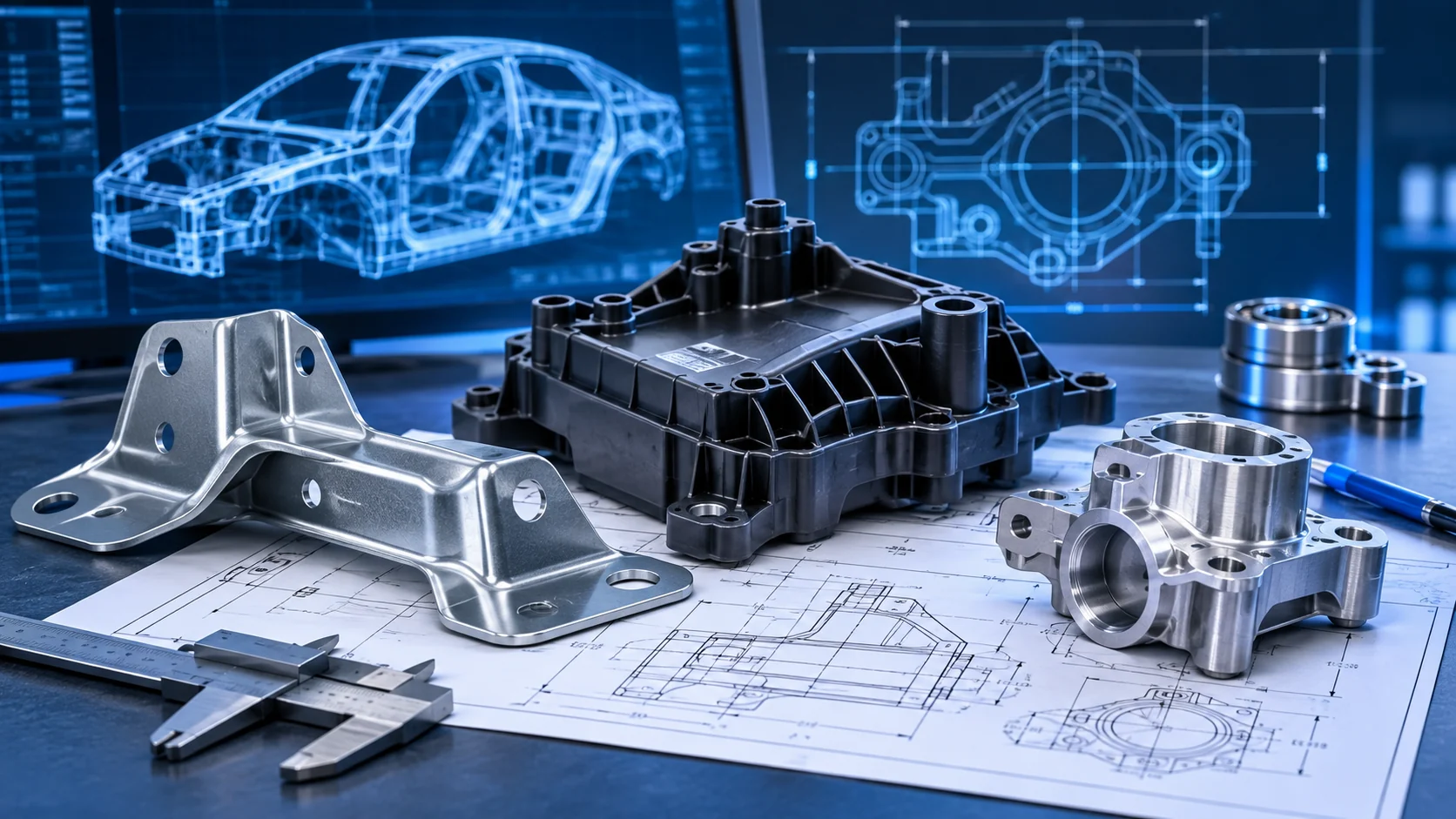
Mechanical design engineering components including a formed sheet metal bracket, plastic housing and machined part on an engineering drawing
Mechanical component design, drawing interpretation and manufacturing considerations · Illustrative visual
ENGINEERING PRACTICE & RELEASE EVIDENCE

Mechanical design standards and engineering outputs

Mechanical component engineering requires consistent drawing interpretation, material and process selection, geometric definition and verification planning. Depending on the component and customer, references may include ASME Y14.5 or ISO GPS, material specifications, applicable product regulations and the organisation’s quality-management procedures. The controlling standard and revision should be identified before interpreting requirements.

Practical outputs can include a component function and interface brief, material/process rationale, DFM/DFA review, engineering drawing and datum scheme, tolerance study, design-risk record, verification plan and revision-controlled design-review summary.

Download the companion field guide: use the Automotive Engineering Design Release Readiness Field Guide (PDF) as a review aid alongside the applicable customer requirements and controlled standards.

FROM ENGINEERING FUNDAMENTALS TO DESIGN PRACTICE

From Mechanical Engineer to Industry-Ready Design Engineer

A mechanical engineering qualification builds the foundation. Product design roles also require the ability to interpret requirements, understand component function, select suitable materials and processes, communicate dimensions and evaluate manufacturing and assembly feasibility.

Understand the componentRelate geometry to function, loads, interfaces, packaging and operating conditions.
Design for productionConsider forming, moulding, machining, joining, fastening and assembly access early.
Communicate design intentRead engineering drawings, apply dimensional controls and document design decisions.
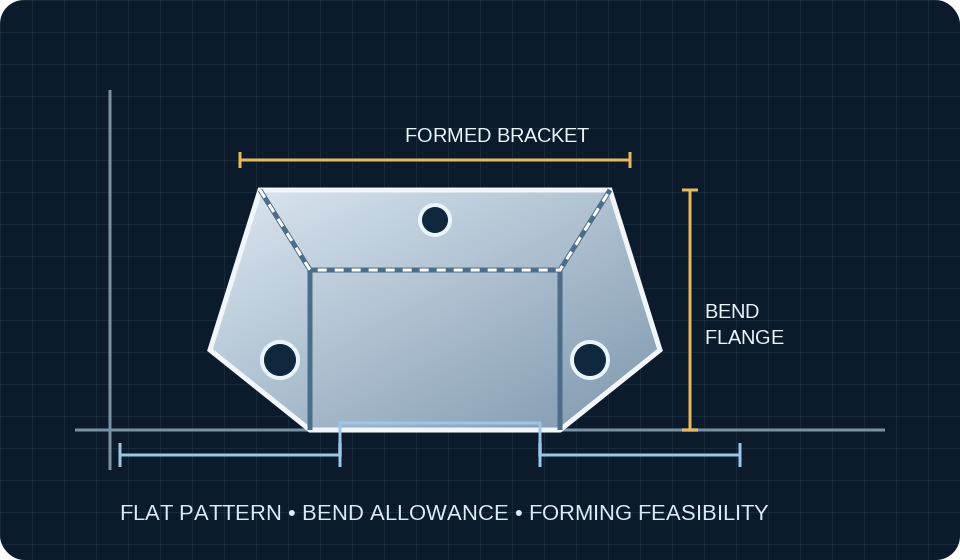
Conceptual sheet metal bracket illustration showing formed flanges, bend features and flat pattern development
Sheet metal design connects component function, material thickness, bend geometry and manufacturing process planning.
LEARNING MODULES

What You Will Learn in Mechanical Design

Build a connected understanding of component design, engineering communication and manufacturing feasibility.

01 · SHEET METAL

Sheet Metal Design

Understand sheet metal fundamentals and the design choices behind brackets, mounting plates, enclosures and formed components.

  • Material and thickness selection
  • Bend radius, bend allowance and bend relief
  • Flanges, hems, louvers and flat patterns
  • Punching, bending, forming, welding and joining
  • Manufacturing feasibility and assembly design
Explore sheet metal design
02 · PLASTICS

Plastic Product Design

Learn how plastic components are designed for injection moulding, fit, durability and repeatable production.

  • Engineering plastics and material properties
  • Wall thickness, draft, ribs and bosses
  • Snap-fits, mounting and fastening
  • Parting lines, undercuts and tooling concepts
  • Injection moulding fundamentals and DFM
Explore plastic product design
03 · DIMENSIONAL CONTROL

GD&T & Engineering Drawings

Interpret dimensions and geometric controls in the context of function, manufacturing and inspection.

  • Datum reference frames
  • Form, orientation, location and profile
  • Feature control frames and position
  • MMC / LMC concepts
  • Tolerance stack-up and drawing interpretation
Explore GD&T & Dimensional Engineering
04 · DESIGN DEVELOPMENT

3D Part & Assembly Design

Understand how component geometry, part interfaces and assembly relationships are developed and documented.

  • 2D sketching and constraints
  • 3D part and feature-based modelling concepts
  • Assembly relationships and interfaces
  • Design changes and drawing creation
  • Engineering documentation
Design Reviews & Documentation
05 · MANUFACTURABILITY

DFM & DFA

Evaluate whether a component can be manufactured and assembled consistently, efficiently and safely.

  • Manufacturing process selection
  • Component manufacturability
  • Assembly access and fastening
  • Material and process constraints
  • Design simplification and cost awareness
DFM Engineering · DFA Engineering
06 · PRODUCT CONTEXT

Automotive & EV Fundamentals

Connect mechanical design principles to vehicle systems, interfaces and application-specific constraints.

  • BIW and structural sheet metal components
  • Interior and exterior plastic components
  • Mounting, packaging and joining interfaces
  • EV battery enclosure fundamentals
  • Product development and validation context
Automotive Fundamentals

MODULE 01 · SHEET METAL ENGINEERING

Sheet Metal Design: From Flat Blank to Functional Component

Sheet metal components are used in brackets, supports, covers, enclosures and automotive body structures. Design decisions must consider material behaviour, thickness, bend geometry, forming direction, joining access and the final assembly interface.

Key engineering topics

  • Material grades, thickness and application requirements.
  • Bend radius, bend allowance, bend deduction and relief concepts.
  • Flanges, hems, louvers, beads, slots and mounting features.
  • Flat pattern development and bend sequence awareness.
  • Punching, bending, stamping, welding and fastening considerations.
  • Edge conditions, tool access, distortion and assembly feasibility.

Illustrative practical exercise

Develop a sheet metal bracket or enclosure study. Identify the component function, mounting datums, material and thickness assumptions, bend strategy, manufacturing route and inspection dimensions. The exercise should explain why each feature is present—not only show the resulting geometry.

Continue into BIW Engineering · Review manufacturing processes

MODULE 02 · PLASTIC PRODUCT ENGINEERING

Plastic Product Design for Injection Moulding

Plastic product design balances function, appearance, material behaviour, mouldability, assembly and durability. Features such as ribs, bosses, snap-fits and mounting interfaces must be considered together with wall thickness, draft, parting strategy and tooling access.

Key engineering topics

  • Engineering plastics and material properties.
  • Wall thickness consistency and transition management.
  • Draft angles, ribs, bosses and local reinforcement.
  • Snap-fit design, fastening and mounting strategy.
  • Parting lines, undercuts, slides and tooling mechanisms.
  • Injection moulding fundamentals and manufacturability reviews.

Example component studies include automotive dashboard features, door trim details, housings, covers, brackets and interior product components.

Explore Interior Product Engineering · Explore Exterior Product Engineering

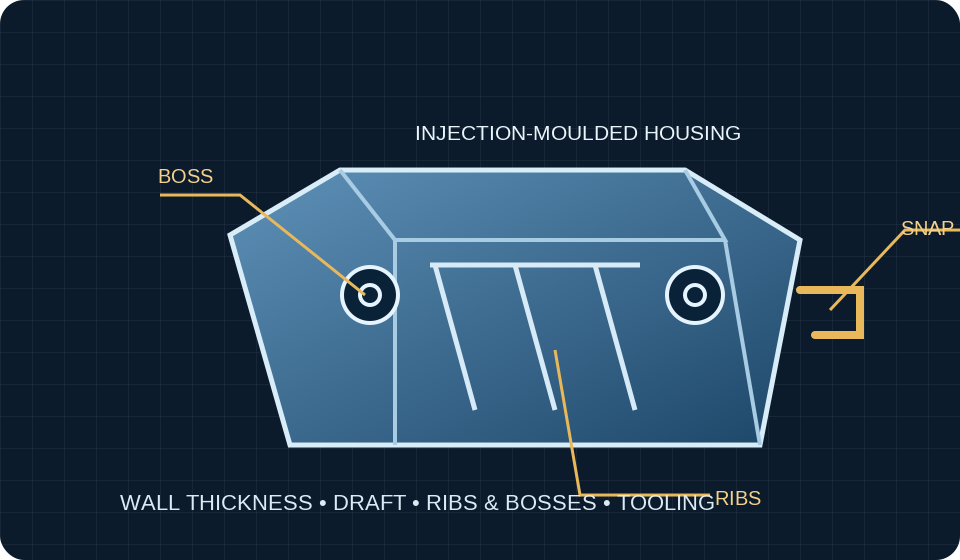
Conceptual injection moulded plastic housing showing ribs, bosses, draft and snap-fit design features
Conceptual plastic housing visual identifying common design features for moulding and assembly reviews.

MODULE 03 · ENGINEERING DRAWINGS & GD&T

GD&T: Communicate Functional Design Requirements

Geometric Dimensioning and Tolerancing provides a structured language for communicating dimensional and geometrical requirements between design, manufacturing and quality teams. Learners should connect drawing symbols and datum schemes to component function, assembly relationships and inspection strategy.

Key engineering topics

  • Drawing interpretation and dimensional fundamentals.
  • Datum features and datum reference frames.
  • Form, orientation, location and profile tolerances.
  • Feature control frames and position tolerance.
  • Maximum Material Condition (MMC) and Least Material Condition (LMC) concepts.
  • Worst-case and statistical tolerance stack-up fundamentals.

The learning pathway introduces principles and drawing-reading practice. Application to a production component must follow the applicable drawing requirements, customer standards and current edition of the relevant standard.

Open GD&T & Dimensional Engineering · Study tolerance stack-up

LEARN · APPLY · REVIEW

Practical Engineering Assignments

Component-based exercises help learners connect engineering intent with manufacturing, assembly and documentation.

Sheet Metal Bracket Design

Study function, material, thickness, bends, mounting interfaces and manufacturing route.

Sheet Metal Enclosure

Explore flat pattern development, bend sequence, fastening, access and assembly feasibility.

Plastic Housing Design

Review wall thickness, ribs, bosses, draft, snap-fits and injection moulding considerations.

Drawing & GD&T Analysis

Interpret datum schemes, geometric controls, critical dimensions and tolerance relationships.

Automotive Component Study

Map component function, interfaces, materials, joining and design constraints within a vehicle system.

EV Battery Enclosure Study

Explore enclosure packaging, structural interfaces, sealing and manufacturing considerations.

These are illustrative learning assignments and engineering case studies. They should not be represented as confidential OEM projects or authorised live industry work unless the specific project authorisation is confirmed.

WHO THIS PATHWAY SUPPORTS

Who Can Join Mechanical Design Training?

Designed for learners with a relevant mechanical or manufacturing engineering foundation.

B.Tech / B.E. Graduates

Build practical design knowledge and prepare to discuss component function, manufacturing and engineering drawings.

Diploma Holders

Strengthen understanding of component design, manufacturing processes, assembly and drawing interpretation.

Automobile & Production Engineers

Connect mechanical fundamentals with automotive product development and component engineering.

Fresh Graduates

Build technical foundations and component-based assignment experience to support interview preparation.

Working Professionals

Refresh or extend knowledge in sheet metal, plastic product design, GD&T and manufacturing methodologies.

Career Restart Candidates

Rebuild confidence through structured technical refreshers, practical exercises and career preparation. Career gaps are not a reason to exclude a learner.

Career Opportunities After Mechanical Design Training

Mechanical design knowledge can be applied across automotive, manufacturing, engineering services and product development. Depending on educational background, demonstrated capability, experience and employer requirements, possible role pathways may include:

  • Mechanical Design Engineer
  • Product Design Engineer
  • Sheet Metal Design Engineer
  • Plastic Product Design Engineer
  • Design and Development Engineer
  • Automotive Design Engineer
  • Junior Product Development Engineer
  • GD&T / Dimensional Engineering Associate

Training is intended to build relevant technical capabilities, not promise employment. Actual role eligibility and selection depend on individual skills, experience and recruitment requirements.

Why MYTECHLEARN?

  • Engineering-focused learning connected to automotive product development.
  • Sheet metal and plastic product design concepts.
  • GD&T and engineering drawing interpretation.
  • Manufacturing-oriented design methodology.
  • Component-based assignments and technical case studies.
  • Progression into automotive and EV engineering specialisations.
  • Technical guidance and interview preparation.

COMMON QUESTIONS

Mechanical Design Course – FAQs

Which is the best Mechanical Design Course in Hyderabad?

Compare programmes by their coverage of component design, sheet metal, plastic product design, engineering drawings, GD&T, manufacturing and assembly principles, practical exercises and transparent learner support. Review the current syllabus and batch details before enrolling.

Can a B.Tech Mechanical graduate join?

Yes. The learning pathway is intended for mechanical engineering graduates and other relevant engineering backgrounds who want to strengthen practical design knowledge.

Is this suitable for Diploma Mechanical students?

Yes. Diploma holders can build their foundation in component design, manufacturing processes, assembly and engineering drawing interpretation.

Will I learn sheet metal and plastic product design?

Yes. The learning pathway covers sheet metal fundamentals, bend features, flat patterns, plastic wall thickness, draft, ribs, bosses, snap-fits and injection moulding considerations.

Does the programme include GD&T?

Yes. It introduces datums, geometric tolerances, feature control frames, drawing interpretation and tolerance stack-up concepts.

Can I move into automotive design after Mechanical Design?

Mechanical Design provides a foundation for further learning in BIW, interior, exterior, seating, EV and dimensional engineering. Specialist roles may require additional domain depth and experience.

Are course duration and fees published?

Duration, batch schedules, delivery details and fees are shared during counselling based on the current programme. Ask for written confirmation of the current cohort details.

Does MYTECHLEARN guarantee placement?

No job or salary is guaranteed. Career guidance and interview preparation may be provided as part of the learner support pathway; exact scope and terms should be confirmed during counselling.

START YOUR ENGINEERING JOURNEY

Build Your Mechanical Design Capability with MYTECHLEARN

Discuss your academic background, current skills and target engineering role. Our team can explain the relevant learning pathway, current batch syllabus and career-support scope.

Book Your Free Technical DemoView Training Programmes

Explore Career Roadmap · Training for Freshers

Mechanical design learning outcomes

Mechanical design learning connects part geometry to function, load, material, manufacturing, joining, assembly and dimensional requirements. The focus is engineering decisions and documentation for automotive components.

Key Mechanical Design Course in Hyderabad with an Automotive F review points

Practical Mechanical Design Course in Hyderabad with an Automotive F learning activity

Choose a mechanical component and document its function, material, process, critical interfaces and inspection requirements.

Admissions open · Hyderabad

Build practical Mechanical Design Course in Hyderabad with an Automotive F engineering capability

Talk to an admissions engineer about the right domain, batch and learning path. Free technical demo, no obligation.

Talk to an admissions engineer

Call MYTECHLEARN WhatsApp
Free DemoWhatsApp