
HYDERABAD, TELANGANA, INDIA AUTOMOTIVE PRODUCT DESIGN & ENGINEERING ACADEMY

MYTECHLEARN · METHOD · CAPABILITY

Generative Design

Topology and generative approaches for lightweighting and performance-driven component design within automotive constraints, from design-space setup to production-ready geometry and verification.

Generative Design: Loads · Topology · Validation
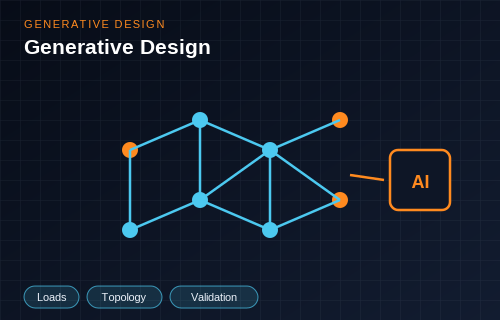
Generative design workflowDefine loads and limits, explore topologies, then validate the result. Original learning illustration, not an OEM drawing.
Scope note: This page is an engineering explainer. The tools, duration and project deliverables for any MYTECHLEARN programme are confirmed in writing by the team for each intake.

01 · What generative design means

Generative design is a constraint-led approach to exploring multiple candidate solutions for a defined engineering problem. The engineer establishes a design space, objectives, loads, boundary conditions, keep-out regions, interfaces and manufacturing constraints. A computational solver then generates or evaluates candidate forms that can be compared against the stated objectives.

Topology optimisation is related but not identical: it typically redistributes material within a defined design space to meet an objective and constraints. Generative-design workflows may combine optimisation, rule-based generation and multi-objective exploration.

02 · Automotive application areas

Brackets and mounts

Explore material-efficient geometry while maintaining bolt interfaces, stiffness, strength, fatigue and assembly access.

EV battery structures

Study support members and local reinforcements with explicit load cases, crash-related constraints, thermal needs, sealing interfaces and manufacturability.

Chassis and structural parts

Compare concepts for stiffness, mass and load paths while accounting for forming, casting, extrusion, machining or additive manufacturing routes as applicable.

Interior carriers and supports

Investigate lightweight support geometry while preserving attachment points, package, occupant-contact requirements, squeak-and-rattle controls and assembly sequence.

03 · Typical workflow

  1. Define design intent: identify function, interfaces, performance targets and the design decision to be informed.
  2. Prepare the design space: establish preserved regions, obstacles, connection zones and packaging boundaries.
  3. Define physics and constraints: apply appropriate loads, supports, contacts, material data, displacement or stress limits and relevant load cases.
  4. Set manufacturing rules: account for casting, stamping, machining, additive or other intended processes, including minimum feature sizes and tool access.
  5. Explore and compare: review candidate solutions against mass, stiffness, strength, durability, cost, process risk and robustness—not a single score alone.
  6. Reconstruct production geometry: create practical Design geometry, add radii and interfaces, and check assembly and service requirements.
  7. Verify and release: perform appropriate analysis, design reviews, prototype or test correlation, drawing definition and change control.

04 · Critical engineering checks

  • Boundary conditions: unrealistic constraints or loads can produce misleading shapes.
  • Load cases: include relevant operating, misuse, durability and safety cases as required by the application.
  • Material assumptions: verify material model, anisotropy, temperature and process effects where relevant.
  • Manufacturing feasibility: ensure the result can actually be produced, inspected, joined and repaired.
  • Interfaces: preserve datums, fastener access, sealing surfaces, clearances and mating geometry.
  • Validation: independently verify the reconstructed design; solver output alone is not product validation.

05 · Relationship to other methods

Generative design complements DFM, DFA, materials engineering, packaging and interfaces and design verification and validation. It may be supported by AI-assisted engineering for scripting, data preparation or workflow automation, but AI assistance is not a substitute for sound optimisation setup or engineering review.

06 · Common pitfalls

Optimising only for minimum mass

A lightweight candidate may fail stiffness, fatigue, crash, vibration, cost or manufacturing requirements. Define a balanced set of objectives and constraints.

Ignoring production geometry

Raw solver output may be difficult to tool, inspect, join or assemble. Reconstruction and detailed design are essential engineering stages.

Using unverified inputs

Incorrect loads, material properties or support conditions undermine the result. Record assumptions and obtain review of the model setup.

07 · Learning and portfolio evidence

A meaningful study can document the design brief, design-space model, boundary conditions, manufacturing assumptions, candidate comparison, selected concept, Design reconstruction and verification plan. Label simulated or academic work accurately; do not present it as a released OEM component or production-approved design.

For related examples, explore engineering case studies, the project library and portfolio development.

08 · Scope and next step

How this subject is delivered, whether as a standalone module, an integrated exercise or an introductory workshop, is confirmed for each intake. Ask about the current tool stack, prerequisites, learning outcomes and assessment method through the contact page.

Continue exploring connected topics and practical learning resources.

Generative Design: from requirements to engineering evidence

Generative design explores candidate geometries under defined design space, loads, constraints, material properties, manufacturing routes and optimisation objectives. The output is a candidate for engineering evaluation—not an automatically approved component.

Generative Design workflow and engineering decision points

A responsible study defines boundary conditions, load cases, supports, keep-out regions, interfaces, safety factors, material model and manufacturing constraints. Mesh sensitivity, solver assumptions and interpretation of stress or displacement results require engineering review.

Generative Design: illustrative engineering example

A lightweight topology may be difficult to cast, print, machine or inspect. Manufacturing constraints, fatigue, buckling, damage tolerance, joining, surface finish and validation must be considered before a concept can progress.

Explore product development learning

Technical discussion

Discuss Generative Design with MYTECHLEARN

Share your background and the engineering domain you want to build. We will explain the learning scope and practical next steps.

PROGRAMME LEARNING PATHWAY

Generative Design: learning sequence

This domain pathway is organised as a progressive learning sequence. The trainer should adapt depth and exercises to the learner's prior knowledge and the confirmed batch plan.

  1. Module 1. Define design space, loads, constraints and objectives
  2. Module 2. Set material, manufacturing and boundary-condition assumptions
  3. Module 3. Generate and compare candidate concepts
  4. Module 4. Review manufacturability, interfaces and engineering constraints
  5. Module 5. Validate selected geometry and document design rationale

Applied learning evidence

Illustrative learning output: Generative-design concept evaluation and manufacturability review. Learners should explain assumptions, engineering decisions, constraints and verification evidence. Any sample drawing or calculation is a learning exercise, not an OEM-approved design.

How progress can be reviewed

  • Concept and terminology checks
  • Guided engineering exercises and review feedback
  • Documented design rationale and interface checks
  • Final presentation of the learning output and open technical questions

Discuss this learning pathway Compare programmes

Generative design as an engineering exploration method

Generative design explores candidate forms against defined objectives and constraints. A promising shape is only a starting point: manufacturability, material behaviour, joining, inspection, durability and validation determine whether it is a viable engineering solution.

Key Generative Design review points

Practical Generative Design learning activity

Compare two conceptual bracket forms and explain how manufacturing route and inspection access influence the preferred geometry.

Admissions open · Hyderabad

Build practical Generative Design engineering capability

Talk to an admissions engineer about the right domain, batch and learning path. Free technical demo, no obligation.

Talk to an admissions engineer

Applied engineering practice

Generative design result verification

Illustrative exercise: compare generated bracket concepts against the same load cases, boundary conditions, material assumptions, manufacturing route and packaging envelope. Review whether a visually light concept can actually be manufactured, inspected and assembled.

Expected Generative Design learning evidence

Record objective functions, constraints, assumptions, verification results and the engineering rationale for selecting or rejecting each candidate.

Related technical learning: Materials Engineering · Dfm Engineering

Begin your engineering pathway

Apply Generative Design knowledge in an engineering portfolio

Speak with the counselling team about the right domain, the current cohort and what you will produce, then decide with the full facts in writing.

Applying Generative Design in product development

A useful engineering method connects a defined requirement to a decision, an owner, an implementation step and objective evidence. Apply the method in the context of a real component or assembly problem.

Related learning resources

Learning note: Examples and exercises are educational illustrations. Always follow the applicable customer requirements, approved specifications, current standards and authorised engineering processes for production decisions.

Call MYTECHLEARN WhatsApp
Free DemoWhatsApp