
HYDERABAD, TELANGANA, INDIA AUTOMOTIVE PRODUCT DESIGN & ENGINEERING ACADEMY

MYTECHLEARN · DOMAIN · EMERGING

AI-Assisted Engineering

How engineers use AI and automation tools inside real automotive product-development workflows, and the checks that keep AI-assisted work accurate, safe and reviewable.

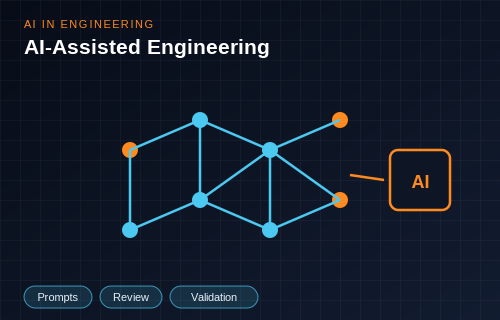
AI-Assisted Engineering: Prompts · Review · Validation
AI as an engineering assistantUse AI to speed up drafting and exploration, then verify every result against engineering evidence. Original learning illustration, not an OEM drawing.
Scope note: This page explains engineering applications and responsible use. The tools, tool access, duration and assessment for any MYTECHLEARN programme are confirmed in writing by the team for each intake.

01 · What AI-assisted engineering means

AI-assisted engineering uses computational methods to support selected engineering tasks such as searching technical information, organising requirements, automating repetitive data handling, exploring design alternatives and preparing documentation. In automotive product development, these methods sit alongside engineering fundamentals, analysis methods, design reviews, testing and manufacturing knowledge.

AI output is a proposal or aid—not an approved design decision. Engineers remain responsible for checking assumptions, units, boundary conditions, source quality, safety implications and compliance with customer and regulatory requirements.

02 · Practical application areas

Engineering information and requirements

Summarise non-confidential requirements, organise review comments, compare revisions and create traceability drafts. Verify every requirement against the controlled source document.

Design workflow automation

Use scripting or parametric logic to reduce repetitive modelling and data-entry work where the Design system supports it. Validate geometry, references, naming rules and model integrity after automation.

Design exploration

Support option generation and early trade-off studies. Link this work to generative design, topology exploration and lightweighting, while preserving explicit constraints.

Quality and validation support

Help structure DFMEA brainstorming, test matrices or issue summaries. Cross-check risk ratings, failure logic and validation evidence with the responsible engineer. See DFMEA and DVPR.

03 · A controlled engineering workflow

  1. Define the task: specify the engineering question, intended user and decision the output may support.
  2. Set boundaries: provide approved inputs, units, assumptions, design constraints and exclusions.
  3. Generate assistance: use the selected tool to draft, classify, calculate or explore alternatives.
  4. Verify independently: check calculations, geometry, references, source documents and edge cases using approved engineering methods.
  5. Review risk: assess safety, privacy, intellectual property, cybersecurity and customer-data restrictions.
  6. Record the decision: identify the tool-assisted output, reviewer, verification evidence and final engineering approval.

04 · Automotive examples

Requirements and change management

An AI assistant may help group incoming comments by topic or prepare a first-pass change summary. The engineer must confirm the effect on part geometry, interfaces, BOM, validation, timing and release status. Related: ECR/ECN change management.

Design and manufacturing reviews

AI can help turn a checklist into a review agenda or highlight missing fields in a draft. It cannot replace supplier feasibility, tooling review, tolerance analysis or manufacturing sign-off. Related: DFM and design reviews and documentation.

Technical knowledge support

AI can help explain terminology and locate topics for further study. Confirm technical values against controlled standards, OEM specifications and approved references. The automotive engineering glossary is a useful starting point.

05 · Data, safety and quality guardrails

  • Never upload confidential OEM, supplier, customer, personal or export-controlled information to an unapproved AI service.
  • Do not treat generated dimensions, material properties, loads, safety factors or regulatory interpretations as authoritative.
  • Use traceable, approved sources for standards and specifications; check revision and applicability.
  • Validate scripts and automated outputs on representative test cases before using them in a live workflow.
  • Keep human review and formal engineering release controls in place.

06 · Skills that support adoption

Useful foundations include mechanical design, engineering drawings, GD&T, Design discipline, data handling, basic scripting concepts, requirements management and critical review. A sound understanding of the product domain is more important than familiarity with a particular AI interface.

07 · Relationship to generative design

AI-assisted engineering is a broad set of methods for supporting engineering work. Generative design is a more specific design-space exploration approach in which objectives, constraints and manufacturing rules are used to produce and compare candidate geometries. The terms are related but not interchangeable.

08 · Explore related engineering topics

Connect this topic with product development, engineering project examples, practical assignments and the wider MYTECHLEARN programmes. To confirm the current curriculum and tool coverage, contact the team.

Continue exploring connected topics and practical learning resources.

AI-Assisted Engineering: from requirements to engineering evidence

AI-assisted engineering can support research synthesis, checklist drafting, requirements organisation, meeting-note structuring and first-pass analysis. It should be treated as an assistant to a controlled engineering process, not as an authority on design safety or compliance.

AI-Assisted Engineering workflow and engineering decision points

A safe workflow defines the task and source data, constrains the prompt, checks every technical statement against approved references, records assumptions, reviews calculations independently and obtains qualified approval before release.

AI-Assisted Engineering: illustrative engineering example

Do not upload confidential drawings, customer data, personal information or controlled technical information to an AI service unless the organisation’s data policy explicitly permits it. AI-generated outputs may be incomplete, fabricated or based on outdated information.

Explore engineering methods and resources

Technical discussion

Discuss AI-Assisted Engineering with MYTECHLEARN

Share your background and the engineering domain you want to build. We will explain the learning scope and practical next steps.

PROGRAMME LEARNING PATHWAY

AI-Assisted Engineering: learning sequence

This domain pathway is organised as a progressive learning sequence. The trainer should adapt depth and exercises to the learner's prior knowledge and the confirmed batch plan.

  1. Module 1. Identify suitable engineering tasks and data boundaries
  2. Module 2. Prepare controlled inputs and evaluate output quality
  3. Module 3. Use AI for exploration while retaining engineering review
  4. Module 4. Check traceability, confidentiality and intellectual-property risks
  5. Module 5. Document human approval and verification of generated outputs

Applied learning evidence

Illustrative learning output: AI-assisted workflow with verification and human-approval checklist. Learners should explain assumptions, engineering decisions, constraints and verification evidence. Any sample drawing or calculation is a learning exercise, not an OEM-approved design.

How progress can be reviewed

  • Concept and terminology checks
  • Guided engineering exercises and review feedback
  • Documented design rationale and interface checks
  • Final presentation of the learning output and open technical questions

Discuss this learning pathway Compare programmes

Responsible use of AI in engineering learning

AI-assisted engineering can support information organisation, draft comparison tables, checklist preparation and explanation of unfamiliar concepts. It must not replace engineering judgement, controlled requirements, validated calculations or authorised approvals.

Key AI-Assisted Engineering review points

Practical AI-Assisted Engineering learning activity

Use an AI-assisted draft to organise a public-domain material comparison, then verify every property and cite its source before using the result.

Admissions open · Hyderabad

Build practical AI-Assisted Engineering engineering capability

Talk to an admissions engineer about the right domain, batch and learning path. Free technical demo, no obligation.

Talk to an admissions engineer

Applied engineering practice

AI-assisted engineering verification exercise

Illustrative exercise: use an AI tool to draft a checklist from a non-confidential component requirement. Verify every generated item against the source requirement, controlled standards and engineering judgement; remove unsupported or ambiguous statements.

Expected AI-Assisted Engineering learning evidence

Keep source traceability, human review, data privacy and revision control. Do not upload confidential OEM, supplier or personal information to unapproved systems.

Related technical learning: Design Reviews Documentation · Engineering Standards References

RESPONSIBLE ENGINEERING PRACTICE

AI-assisted engineering: frequently asked questions

AI can support engineering workflows, but technical accountability remains with qualified people and approved processes.

Can AI replace automotive engineering judgement?

No. AI may help organise information, explore alternatives or draft documentation, but engineers remain responsible for requirements interpretation, design decisions, calculations, verification, safety and release approval.

How can AI support product-development work?

Potential uses include searching approved knowledge, summarising requirements, structuring review checklists, comparing documented alternatives and supporting draft reports. Outputs must be checked against controlled engineering sources and project requirements.

Can AI-generated technical answers be treated as verified facts?

No. Generated outputs can be incomplete, outdated or incorrect. Validate technical values, standards references, material data, tolerances and regulatory requirements against authoritative and current documents before use.

Is it safe to upload OEM or supplier information to public AI tools?

Do not upload confidential, proprietary, personal or export-controlled information to a tool unless your organisation has explicitly approved that service and data-handling arrangement. Follow applicable confidentiality, cybersecurity and intellectual-property requirements.

What should an engineer document when using AI?

Record the engineering question, approved source inputs, tool or model used where required by policy, assumptions, human checks, verification evidence and the responsible reviewer. Follow the organisation's document-control and change-management process.

Begin your engineering pathway

Apply AI-Assisted Engineering knowledge in an engineering portfolio

Speak with the counselling team about the right domain, the current cohort and what you will produce, then decide with the full facts in writing.

Applying Ai Assisted Engineering in product development

A useful engineering method connects a defined requirement to a decision, an owner, an implementation step and objective evidence. Apply the method in the context of a real component or assembly problem.

Related learning resources

Learning note: Examples and exercises are educational illustrations. Always follow the applicable customer requirements, approved specifications, current standards and authorised engineering processes for production decisions.

Call MYTECHLEARN WhatsApp
Free DemoWhatsApp